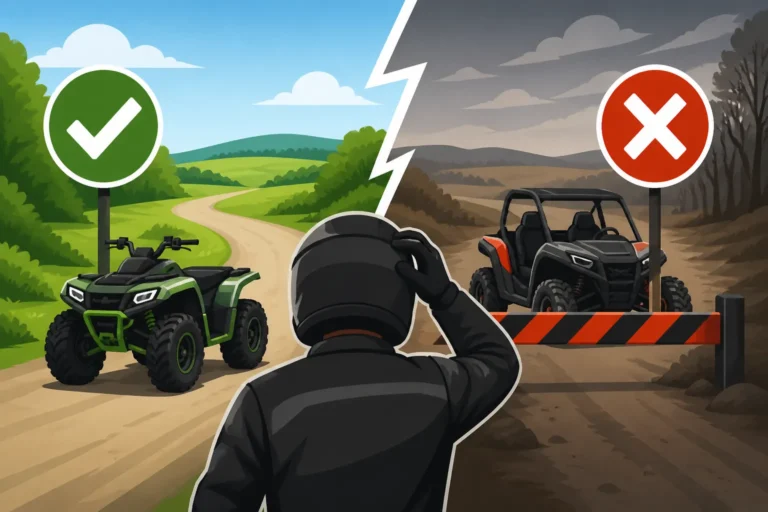
Riding in Strong Township
Navigating the specific rules and regulations for riding your ATV or UTV on municipal roads can be a real headache, especially when every township seems to have its own unique set of by-laws. It's frustrating to want to legally connect from your property to a trail, or just run to the corner store, only to be unsure if you're breaking the rules. This guide is here to clear the confusion and provide a comprehensive look at what you need to know to ride your off-road vehicle safely and legally within Strong Township, giving you the confidence to hit the road.
Deciphering Strong Township's ORV By-Law: What You Need to Know
For many of us who love the open air and the rumble of our off-road vehicles, the thought of taking our quad or side-by-side on a public road can be daunting. You hear stories about different municipalities having different rules, some open, some closed, and it's enough to make your head spin. Strong Township, nestled in the Parry Sound District, is no exception to this patchwork of local regulations. Understanding their specific by-law is the first, and most crucial, step before you even think about engaging the throttle on a paved or gravel road.
Unpacking Strong Township's ORV By-Law
The primary reason municipalities like Strong Township create their own ORV by-laws is to strike a balance between providing access for riders and maintaining community safety, managing noise levels, and addressing resident concerns. These local rules supplement, and sometimes restrict, the broader provincial regulations outlined in the Off-Road Vehicles Act. It’s not about making things difficult for riders; it's about tailoring rules to the specific needs and landscape of the community. For instance, a township with many residential areas might have stricter rules than one with vast rural stretches.
When you're trying to figure out where you can and can't ride, you might find yourself poring over maps or trying to recall snippets of conversations. It’s always best to go straight to the source. The official "Strong Township's ORV By-law" document is the definitive guide for riders in the area. This document will detail exactly which roads, if any, are open for ORV use. Typically, by-laws differentiate between main arterial roads, secondary roads, and sometimes even unopened road allowances. For example, you might be looking to ride from your cottage on a quieter side road down to a local store or a trail access point on a secondary road. It's absolutely crucial to know if that specific stretch is allowed, because riding on a prohibited road, even for a short distance, can lead to fines. This is exactly why it's so important to be familiar with [Checking a Township's ORV By-law] directly.
Permitted Routes, Speed Limits, and Time Restrictions
Once you’ve got your hands on Strong Township’s specific ORV by-law, you'll need to carefully review the sections pertaining to permitted routes. Most municipal by-laws will list roads by name, or describe them by classification (e.g., "all municipal roads except County Road X and Highway Y"). It's rare for all roads in a township to be open to ORVs, especially main thoroughfares or those with heavy traffic. The goal is often to provide connectivity to trail systems or allow access to services, rather than unrestricted joyriding on all public ways.
Beyond simply identifying which roads are open, the by-law will also dictate the conditions under which you can ride. Speed limits are a huge one, and they often differ from the posted limits for cars. Provincially, ORVs generally face a maximum speed of 20 km/h on roads where the posted limit is 50 km/h or less, and 50 km/h on roads where the posted limit is over 50 km/h. Strong Township’s by-law will incorporate these general rules, but might also add its own specific limitations for certain areas or roads. Imagine planning a morning ride to grab coffee only to find out you can't be on that road before 8 AM due to a local noise ordinance. It's frustrating, but these rules are often put in place to maintain peace for residents, so respecting them is vital for continued access. [Why One Township Road Is Open and the Next Closed] often comes down to these kinds of local considerations. Additionally, some by-laws might include seasonal or hourly restrictions, perhaps closing certain roads during the spring thaw to prevent damage, or limiting riding to specific hours to reduce noise impact on residential areas. Always check for these nuances in the by-law.
Getting Your ORV Ready for Strong Township Roads: Equipment and Documentation
So, you've done your homework, found the Strong Township ORV by-law, and identified the roads you can legally ride. Fantastic! But before you even think about turning the key, you need to ensure both your machine and you, as the rider, are fully compliant with all the necessary provincial and local requirements. This isn't just about avoiding a ticket; it's about safety for yourself, other road users, and maintaining a positive image for the entire riding community. Getting these ducks in a row can feel like a chore, but it's a non-negotiable part of responsible riding.
Equipping Your ATV or UTV for Road Use
Hitting the pavement or gravel with your off-road vehicle means it needs to meet certain "street legal" standards, which are often different from its stock configuration designed purely for trails. In Ontario, any ORV operating on a public road must be equipped with essential safety features. This generally includes proper headlights, tail lights, and brake lights that are functioning correctly. You'll also need a horn and an adequate muffler to keep noise levels in check. Many stock ORVs might meet these basic requirements, but it's always worth a double-check, especially if you've made modifications.
One crucial item often overlooked or inadequate on many off-road machines is mirrors. For road use, you absolutely need at least one mirror that provides a clear view to the rear. This isn't just a suggestion; it's a legal requirement. Depending on your machine, you might find that stock mirrors are too small, vibrate too much, or simply don't offer the field of vision needed for safe road operation. This is where aftermarket solutions can really come into play. Companies like SuperATV offer a range of mirrors, lighting kits, and other accessories designed to enhance your machine's road legality and safety. Investing in high-quality, road-compliant mirrors or upgrading your lighting can make a significant difference in both your visibility and ability to see what's behind you. It ensures your machine aligns with [Equipment Ontario Requires on a Road-Legal ORV]. Furthermore, for larger machines like UTVs or side-by-sides, it’s vital to be aware of [Ontario ATV Width Limit for Road Use] and [Ontario ATV Weight Limit for Road Use]. An ROV over 2.03 meters wide, for instance, generally falls outside the scope of road-legal use in Ontario, so measure your machine carefully.
The Mandatory Paperwork: Licence, Insurance, and Registration
Having a properly equipped machine is only half the battle; you also need to ensure you're legally authorized to operate it on the road. This means carrying the correct documentation on every ride. First and foremost, you need a valid driver's licence. In Ontario, operating an ORV on a public road requires a minimum of a G2 or M2 licence. A G1 or M1 learner's permit simply won't cut it, so don't risk it. Check your [Ontario ATV Licence Requirements] before you ride.
Next up is insurance, and this is non-negotiable. [Ontario ATV Insurance Requirement] mandates that your ORV must be covered by a Motor Vehicle Liability Policy. This isn't just for accidents; it's a legal requirement just like insuring your car. You must carry proof of this insurance with you at all times when riding on public roads. An insurance card, easily accessible and preferably waterproof, is a must. Many riders keep their proof of insurance along with their permit in a sealed bag, addressing the concern of [Keeping Your ORV Permit Dry on a Wet Ride].
Finally, your off-road vehicle itself needs to be properly registered with the province. This involves [Registering an ATV in Ontario] and ensuring you have a valid permit and licence plate. The [Ontario ORV Plates and Where They Mount] is also specified; the plate must be clearly visible and mounted in the correct location on your machine. The ORV permit, like your insurance, must be carried with you whenever you're riding. And remember, there are strict rules regarding [Ontario ATV Minimum Age on a Road] (16 years old to drive) and [Ontario ATV Passenger Rules], especially on single-rider machines. If your side-by-side or ATV is designed for a passenger, ensure they are seated properly and meet any age or helmet requirements.
| Requirement | Applies to Road Use? | Applies to Off-Road Only? | Notes |
|---|---|---|---|
| Valid Driver's Licence | Yes (G2/M2 minimum) | No (age/supervision rules) | For public roads. |
| ORV Registration | Yes | Yes | Mandatory for all ORVs on public or private land (with exceptions). |
| Licence Plate | Yes | Yes | Must be displayed. |
| Insurance | Yes | Yes | Mandatory Motor Vehicle Liability Policy. |
| Headlights | Yes | Yes | Always required, especially for night riding. |
| Tail Lights | Yes | Yes | Always required, especially for night riding. |
| Brake Lights | Yes | Yes | For signaling stops. |
| Horn | Yes | Yes | For warning others. |
| Muffler | Yes | Yes | Must be adequate, excessive noise can lead to fines. |
| Mirrors | Yes (at least one) | No | Essential for road safety and legality. |
| Seatbelts (for ROVs) | Yes | Yes | If equipped from factory. |
| Specific Width/Weight | Yes | No | Must comply with road-legal limits (e.g., 2.03m width limit). |
| ORV Permit Carried | Yes | Yes | Or a true copy. |
Riding Responsibly in Strong Township and Beyond
Riding an ATV or UTV in Strong Township offers a fantastic way to experience the beautiful Parry Sound region, whether you're commuting to a nearby trail or simply running an errand. However, the privilege of using public roads comes with a significant responsibility to your community, the environment, and fellow outdoor enthusiasts. Your actions on the road, or even off it, contribute to the overall perception of ORV riders, and maintaining a positive image is key to ensuring these access opportunities continue. It’s about being a good neighbour and a thoughtful outdoor user.
Ethical Riding and Community Relations
Noise is perhaps the biggest factor that can sour relations between ORV riders and local residents. While the rumble of your engine is music to your ears, it can be a nuisance to those living along designated ORV routes. Practicing mindful throttle control, especially when passing homes or in populated areas, is essential. Avoid unnecessary revving and keep your speed appropriate for the environment, even if the by-law allows for a higher limit. If your machine has an aftermarket exhaust that's significantly louder than stock, it might be worth considering a quieter alternative or using a spark arrestor/silencer to mitigate sound. Companies like SuperATV often have exhaust systems that balance performance with noise reduction, helping you stay compliant and courteous.
Dust and mud are another common concern. On gravel roads, try to minimize the dust you kick up, especially when passing pedestrians, cyclists, or other vehicles, and certainly when passing homes. Similarly, if you encounter muddy sections, ride through them respectfully. Don't go out of your way to splash mud onto roads or adjacent properties, as this can create a mess and generate complaints. The golden rule for ORV riders, whether on roads or trails, is to stay off private land unless you have explicit, written permission from the landowner. [Ontario ATV Trespass Rules] are serious, and straying onto someone's property not only carries fines but also erodes trust within the community. Strong Township is part of a beautiful natural area, so also be mindful of wildlife. Reduce your impact by staying on designated routes, avoiding sensitive habitats, and always packing out what you pack in.
Leveraging Strong Township Roads for Trail Access
The true value of open municipal roads in Strong Township, for many riders, lies in their ability to act as crucial connectors to broader trail networks. Instead of having to trailer your machine everywhere, designated roads allow you to seamlessly transition from your driveway or cottage to the start of an incredible adventure. These connections are vital for supporting local tourism and giving riders more flexibility. Once you transition from a municipal road to a designated trail system, such as a club trail that forms part of [Ontario's OFATV Trail Network], remember that a separate trail permit will almost certainly be required.
While Strong Township's by-law focuses on its local roads, it's worth considering how these roads can lead you to larger riding opportunities. The Parry Sound and Muskoka regions are rich with trail systems, and Strong Township often provides the essential links. For example, knowing the local roads allows you to ride directly to the staging area for the [Voyageur Multi-Use Trail] or connect to other parts of the network near Huntsville or Parry Sound itself. This interconnectivity enhances the overall riding experience, but it always comes back to having the right [Ontario ATV Trail Permits Explained] for the trails and respecting all local rules on your way there. Before heading out, make sure you know which clubs manage the trails you plan to ride and purchase the appropriate permit.
Disclaimer
This article is for general informational purposes only and does not constitute professional advice. Laws, prices and regulations vary by location and change over time. Consult a qualified professional for guidance on your specific situation.