A Machine Just Over 1,700 Kilograms
Navigating the world of off-road vehicles (ORVs) in Ontario can feel like a maze, especially when you start looking at the bigger, more powerful machines out there. Many of us invest in these fantastic UTVs or massive ATVs for work around the property, serious trail adventures, or just because we love the capability they offer. But then, the question inevitably arises: "Can I take this magnificent beast on the road, even for a short hop?" The frustration often comes when you realize that size and weight, in particular, can throw a wrench into your plans for legal road use, especially when your machine tips the scales just over 1,700 kilograms. This guide is here to untangle the specific rules and classifications in Ontario that apply to those heavier ORVs, helping you understand what you can and cannot do on public roads.
Understanding Ontario's ORV Weight Classes
Ontario has specific classifications for off-road vehicles, and these classifications are absolutely crucial for determining where and how you can ride. It’s not just about engine size or whether it has a steering wheel or handlebars; weight plays a starring role, particularly if you’re hoping to use your machine on any public road. Many riders are caught off guard by these distinctions, assuming if it's an ORV, it's an ORV. But the province, through its regulations, sees a pretty significant difference between a lightweight quad and a heavy-duty side-by-side, especially once that 1,700-kilogram mark is crossed.
The Critical 1,700 Kilogram Threshold
For a lot of us, when we think of an ATV, we picture the traditional four-wheeler with handlebars, perhaps a 500cc or 700cc engine. These typically fall well below the 1,700-kilogram threshold. However, as side-by-sides (UTVs) have grown in popularity, so has their size and weight. Modern utility side-by-sides, especially those designed for heavy hauling, with full cabs, winches, and robust aftermarket accessories, can easily push past this weight. Think about those heavy-duty rock sliders, big tire and wheel upgrades, or even a full cab enclosure with a heater – every single addition adds pounds.
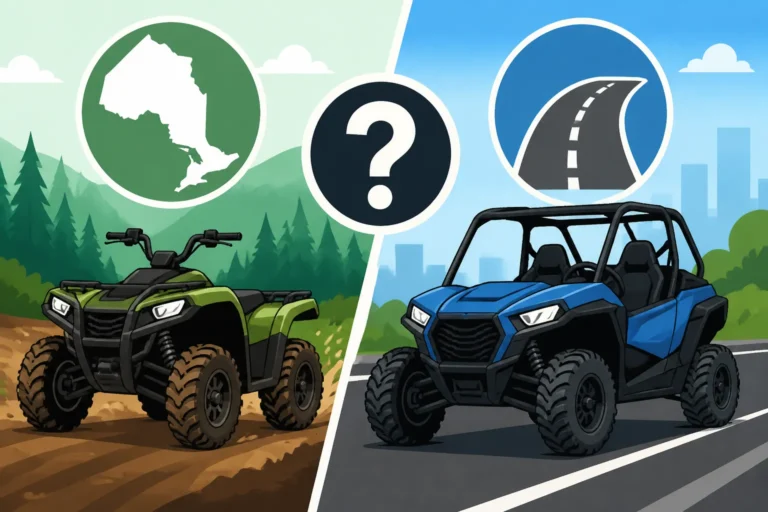
Ontario's regulations specifically define different classes of ORVs. An "all-terrain vehicle" (ATV) is generally defined as a three- or four-wheeled vehicle weighing no more than 600 kilograms (1,323 pounds), with a seat designed to be straddled. Then you have "multi-purpose off-highway motorized vehicles" (MPVs), which are often what people mean when they say "UTV" or "side-by-side." This is where the 1,700-kilogram figure becomes critical. [Ontario's MPV Class and Its Weight Limit] is a designation that generally covers machines weighing more than 600 kilograms but less than or equal to 1,700 kilograms (3,748 pounds). If your machine, as it sits, fully equipped and ready to ride, is a single kilogram over that 1,700-kilogram limit, it no longer fits neatly into the standard MPV category for road-legal operation. This isn't just a minor technicality; it's a fundamental shift in how the province views your vehicle for public road use.
How the Weight Affects Vehicle Classification
So, what happens if your pride and joy, perhaps a rugged six-seater utility UTV or a highly customized off-road buggy, weighs in at 1,701 kilograms? It essentially falls into a bit of a regulatory no-man's land when it comes to being designated an ORV for road use. While it's still an off-road vehicle in spirit and function, for the purposes of riding on public roads in Ontario, it no longer perfectly aligns with the definitions that permit such use under the Off-Road Vehicles Act and related regulations. This can be incredibly frustrating for owners who have invested heavily in their machines, perhaps even adding robust protection like heavy-duty bumpers or cargo systems from companies like SuperATV, which, while enhancing capability, also add to the overall mass.
The province hasn't created a specific "over 1,700 kg ORV" class for road-legal use in the same way it has for ATVs and standard MPVs. This means that a machine exceeding this weight, while still usable on private land, designated trails (where allowed by the trail authority), or Crown Land (where permitted), generally loses its eligibility for municipal road access under the ORV framework. It essentially becomes too heavy to be treated like its lighter counterparts, preventing it from benefiting from the by-laws that allow [Ontario UTV Road Rules] and [Ontario Side-by-Side Road Rules]. This isn't to say it can never touch a road, but its classification changes, and thus, its legal avenues for doing so become severely restricted, often limiting it to scenarios like crossing a highway or agricultural use on specific rural roads, under much stricter conditions.
Navigating Road Use With a Heavier Machine
For those with machines hovering around or slightly above that 1,700-kilogram mark, the path to legal road use becomes significantly more challenging. It's not impossible to move these machines, but understanding the limitations is key to avoiding fines and ensuring your safety and compliance. The provincial rules are designed with specific types of vehicles in mind, and when your machine steps outside those defined parameters, you enter a grey area that municipal by-laws are often not equipped to handle.
Municipal By-laws and Weight Restrictions
Even if your heavier machine were to magically squeeze under the 1,700-kilogram limit, remember that road use for ORVs in Ontario is primarily governed by municipal by-laws. This means that even compliant ATVs and UTVs can only ride on roads in municipalities that have "opted in" by passing their own by-laws. [How an Ontario Municipality Opts In] to allow ORVs on their roads is a multi-step process, and each by-law can have its own nuances. Crucially, these by-laws are almost always drafted based on the provincial definitions for ATVs and MPVs, which cap the weight at 1,700 kilograms. Therefore, if your machine exceeds this weight, it's unlikely to be covered by any municipal by-law that permits ORV road usage.
Imagine you're trying to take your beast of a side-by-side, perhaps one fitted with a heavy-duty plowing attachment or a full utility box, just down the road to a gas station or to connect to a trail system. If that machine is over 1,700 kg, and the local by-law references the provincial definitions, you're technically operating a vehicle not permitted on that road under the ORV by-law. This means you could be subject to fines for riding an unregistered or unapproved vehicle on a public roadway. It's vital to do your homework and [Checking a Township's ORV By-law] before even considering taking a heavier machine onto the pavement. Most by-laws won't explicitly state "no vehicles over 1,700 kg," but by adopting the provincial definitions, they implicitly exclude them.
Equipment and Safety Considerations for Heavier ORVs
Beyond the legal classification, there are practical and safety considerations for operating a very heavy ORV on public roads. Even if a hypothetical exception were made, the sheer mass of these machines impacts their braking distance, acceleration, and handling characteristics. While modern UTVs are incredibly capable off-road, their design parameters for public road use often don't account for extreme weights. This is why you'll see regulations that also cap [Ontario ATV Width Limit for Road Use] at 2.03 metres, ensuring they can safely share the road with other traffic.
Heavier machines also put more strain on tires, suspension, and braking systems, which might not be rated for sustained road speeds or frequent stops under such loads. If you've invested in heavy-duty components from a company like SuperATV, you know they're built tough for the trail, but the road environment presents different challenges. When the provincial and municipal rules were crafted, they were considering the typical ORV, not necessarily a fully loaded, oversized utility machine. This mismatch in design intent and regulatory framework is a significant reason why that 1,700-kilogram mark acts as such a firm barrier to road access. Owners must ensure their machines meet all other safety requirements too, such as proper lighting, mirrors, and seatbelts, which are outlined for road-legal machines.
Options and Considerations for Overweight Machines
So, if your machine is over that 1,700-kilogram limit, what are your options for getting it where you need to go, especially if that involves traversing public land or roads? The reality is that the most straightforward and legally compliant solutions often involve transport rather than direct operation on the road.
Staying Off Public Roads
For many owners of very heavy ORVs, the simplest and most compliant approach is to assume your machine is not road-legal for general travel. This means that if you need to move it from your property to a trailhead, a different piece of land, or even across town, you're going to need a trailer. This might seem like an extra hassle, but it eliminates any ambiguity regarding weight restrictions, municipal by-laws, and the provincial ORV definitions. Investing in a robust trailer that can handle the weight of your machine, plus any gear, is a wise move for anyone with a UTV that's pushing the limits.
Consider the various trails and riding areas that are specifically designed for ORVs. These include extensive networks like the OFATV trails or areas of Crown Land where [Ontario ATV Rules for Riding Crown Land] allow for vehicle use. For these destinations, trailering your machine to a designated staging area or directly to the land where it's permitted ensures you're riding legally. It also opens up a wider range of terrain, as you won't be limited to areas accessible via road-legal ORV paths. This approach ensures you comply with [Ontario ATV Weight Limit for Road Use] without having to constantly worry about an officer’s interpretation of your vehicle’s classification.
Modifying Your Machine and Why It's Tricky for Weight
Some owners might consider modifying their machines to reduce weight. However, this is often a difficult and counterproductive path for heavy machines already above the 1,700-kilogram mark. The components that make these machines heavy – the heavy-duty frames, larger engines, robust suspensions, and extensive accessories – are often integral to their function and capability. Removing essential items like a winch, heavy bumpers, or even certain bed components could compromise the very reasons you purchased the machine, or even its safety.
Furthermore, any significant modifications could impact your vehicle’s certification or warranty. While aftermarket parts from a reputable supplier like SuperATV can enhance performance, they rarely reduce the overall weight in a meaningful way for machines that are already exceeding the provincial limits. Trying to strip down a heavy UTV to get it under 1,700 kg often means compromising its utility, comfort, or safety features, making it a less viable solution than simply opting for trailering. It's often more realistic to accept the machine's inherent weight and plan accordingly for transport.
Beyond Weight: Other Road-Legal Requirements
Even if your machine were under the 1,700-kilogram limit, Ontario has a comprehensive set of rules for road-legal ORV operation. It’s not just about weight, but also about the operator, the machine's condition, and its legal status. Missing any one of these elements can lead to significant penalties.
The Importance of Proper Registration and Insurance
For any ORV, regardless of weight, that you intend to use on public roads where permitted by municipal by-law, proper registration is non-negotiable. This means your machine must have an [Ontario ORV Permit Cost] and display a valid [Ontario ORV Plates and Where They Mount]. The permit links your vehicle to you, and the plate provides visible identification. Without these, even a perfectly compliant lightweight ATV is not legal for road use. The process generally involves registering your ORV at a ServiceOntario centre, proving ownership, and paying the one-time fee. [Registering an ORV at a ServiceOntario Centre] is a straightforward process, but essential.
Equally critical is insurance. [Insurance and Ontario ORV Registration] is mandatory for any ORV operating on public roads or even on trails. You must carry proof of a motor vehicle liability policy, typically a minimum of $200,000. This insurance covers you for any damage or injury you might cause to others while operating your ORV. Riding an uninsured ORV in Ontario can result in substantial fines, making it a risk not worth taking. Your insurance provider will need to know if you plan to use your ORV on public roads, as this can affect your coverage and premiums.
Operator Licensing and Age Requirements
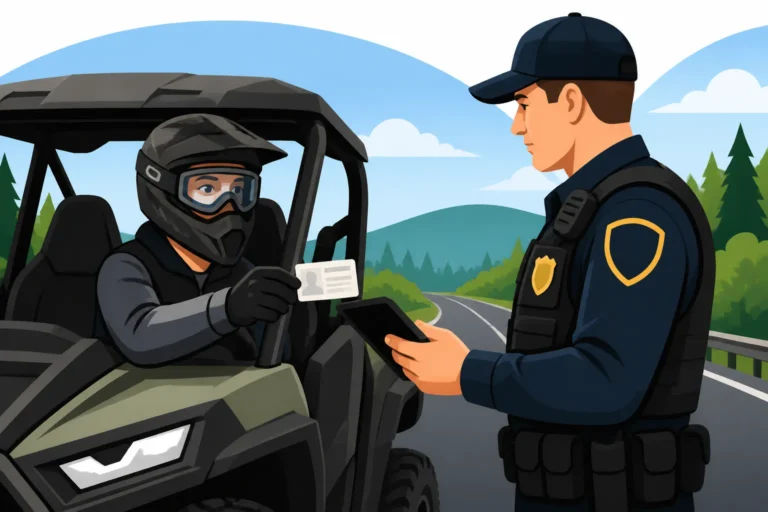
It’s not enough for the machine to be legal; the person operating it must also meet certain criteria. For road use of an ORV in Ontario, the operator must hold a valid Class G2 or M2 driver’s license, at minimum. A G1 or M1 learner's permit is generally not sufficient for operating an ORV on public roads, as it requires supervised driving and has specific restrictions. This applies to both ATVs and side-by-sides within the permitted weight and width classes. [The Licence Ontario Requires on a Road] for ORV operators is a crucial piece of the puzzle.
Furthermore, there are age requirements for operators, which differ between off-road and on-road use. While a 12-year-old may operate an ORV off-road under certain conditions, the minimum age for operating an ORV on a public road where permitted is 16, and they must hold the appropriate license. Passengers also have rules, with some machines being strictly single-rider. These rules are in place to ensure the safety of everyone on the road, given the unique characteristics of ORVs. Taking the time to understand all these requirements before you head out, especially with a heavier machine, is paramount.
Here's a quick reference for common ORV classes and their maximum weight for road use in Ontario:
| ORV Type | Max Weight for Road Use (kg) | Seating Configuration | Common Examples | Road Status in Ontario |
|---|---|---|---|---|
| ATV | 600 kg (approx. 1323 lbs) | Straddled seat, 1 or 2 riders (if designed for it) | Honda Rancher, Polaris Sportsman | Permitted on municipal roads if by-law exists, with proper registration/insurance/license |
| MPV (UTV/SxS) | 1700 kg (approx. 3748 lbs) | Side-by-side seating, steering wheel | Polaris Ranger, Can-Am Defender, Kawasaki Mule | Permitted on municipal roads if by-law exists, with proper registration/insurance/license |
| ROV | 1700 kg (approx. 3748 lbs) | Side-by-side seating, steering wheel (similar to MPV but different safety standards) | Many modern UTVs also fall here, emphasizes roll-over protection | Permitted on municipal roads if by-law exists, with proper registration/insurance/license |
| Over 1700 kg | N/A | Varies widely | Heavy utility UTVs, customized buggies, agricultural equipment | Generally NOT permitted on municipal roads under ORV regulations, exceptions may apply for agricultural purposes or specific equipment. |
This table clearly highlights why a machine just over 1,700 kilograms faces a different reality when it comes to road access.
Disclaimer
This article is for general informational purposes only and does not constitute professional advice. Laws, prices and regulations vary by location and change over time. Consult a qualified professional for guidance on your specific situation.