Ontario ATV Registration After a Sale
Buying an ATV or UTV in Ontario, especially through a private sale, can feel like navigating a maze of paperwork and rules. Many new owners find themselves scratching their heads, wondering exactly what steps they need to take to get their machine legally registered and ready for the trails. This comprehensive guide will walk you through everything you need to know about registering your off-road vehicle after a sale, helping you avoid common pitfalls and get your new ride plated with confidence.
Understanding the Basics of Post-Sale Registration in Ontario
When you've just shaken hands on a deal for a new-to-you ATV or UTV, the excitement is palpable. You're probably already dreaming of hitting the trails and exploring Ontario's incredible backcountry. But before you can legally do that, there's a crucial step: registering the machine in your name. This isn't just a formality; it's a legal requirement that ensures you're recognized as the official owner and allows you to obtain a licence plate, which is essential for riding almost anywhere off your own property.
The Buyer's Responsibility to Register
It’s easy to assume the previous owner handles all the transfer details, especially if they're a long-time rider. However, in Ontario, the onus is squarely on the buyer to complete the registration process. As the new owner, you are responsible for heading to a ServiceOntario centre and initiating the transfer of ownership. This isn't something that happens automatically, nor is it the seller's job beyond providing you with the necessary documents. If you neglect this step, you could face fines, issues with insurance, and problems if your machine is ever involved in an incident or stolen. You literally have a ticking clock to get this done, so don't procrastinate.
The province sets a clear timeframe for this transfer: you generally have [Six Days From Purchase in Ontario] to visit a ServiceOntario centre and register your recently acquired ATV or UTV. Missing this deadline can lead to complications and, potentially, prevent you from registering until you can clarify the delay. Think of it as putting the final, legal stamp on your purchase – it formalizes your ownership in the eyes of the law. Without it, you’re technically riding an unregistered vehicle, even if you have a bill of sale in your hand.
Key Documents You'll Need from the Seller
The success of your registration largely hinges on the documents you receive from the seller. The most critical piece of paper is the original Ontario Vehicle Permit, often referred to as the "green slip" due to its distinctive colour. This permit is essentially the ownership document for the off-road vehicle. It lists the previous owner's details, the vehicle information (like the make, model, and Vehicle Identification Number, or VIN), and importantly, it has sections on the back for transferring ownership. Without this original permit, the process becomes significantly more challenging, so always ensure you get it from the seller. [The Ontario Vehicle Permit Explained] delves into what to look for on this crucial document.
Beyond the permit, a detailed and properly filled-out Bill of Sale is equally vital. While the permit proves the vehicle's history, the Bill of Sale confirms the transaction itself – who bought it, who sold it, when, and for how much. This document should clearly state the buyer's and seller's names and addresses, the date of the sale, a thorough description of the ATV or UTV including its VIN, and the agreed-upon purchase price. It acts as a clear record of your purchase and is required by ServiceOntario for the transfer. Make absolutely sure the VIN on the Bill of Sale matches the VIN on the permit and the physical machine itself. Any discrepancies here will flag your application and could cause significant delays, turning your exciting purchase into a frustrating bureaucratic nightmare.
Navigating the Bill of Sale and Ownership Proof
The Bill of Sale might seem like a simple piece of paper, but its accuracy and completeness are paramount when registering your ATV or UTV after a private sale in Ontario. It's the document that proves you lawfully acquired the machine and is your first line of defense should any questions about ownership arise. Without a solid Bill of Sale, ServiceOntario might raise an eyebrow, and you could find yourself in a challenging situation.
What Makes a Good Bill of Sale?
A robust Bill of Sale isn't just a receipt; it's a legal agreement that protects both the buyer and the seller. At a minimum, it must include the full legal names and addresses of both parties involved in the transaction. The date of the sale is also crucial, as it marks the beginning of your six-day registration window. Next, a detailed description of the ATV or UTV is essential: list the make, model, year, and most importantly, the Vehicle Identification Number (VIN). This VIN is unique to your machine and links the Bill of Sale directly to the specific vehicle being transferred. Lastly, the agreed-upon purchase price must be clearly stated, as this figure will be used to calculate the Retail Sales Tax (RST) you’ll pay at ServiceOntario.
While a handwritten Bill of Sale is perfectly acceptable, as long as it contains all the necessary information and is legible, many people prefer using a template for clarity and professionalism. A resource like LawDepot offers professional, legally sound templates for Bills of Sale, which can give both parties peace of mind and ensure all required fields are covered. Using a template helps prevent omissions that could cause headaches later on. It ensures that critical details, such as a clause stating the machine is sold "as is" (which is common in private sales), are included, clearly defining the terms of the agreement. For more specific details on what Ontario requires, consult [Ontario ATV Bill of Sale Requirements].
Dealing with a Missing Ontario Vehicle Permit
One of the trickiest situations a buyer can encounter is when the seller doesn't have the original Ontario Vehicle Permit. This can happen for various reasons: it might be lost, damaged, or the previous owner may have never properly registered it themselves. While it's tempting to walk away from such a deal, especially if the price is right, be aware that registering a machine without its original permit is significantly more complicated. ServiceOntario requires proof of ownership history, and the permit is the primary document for this. Without it, you're essentially trying to prove you own something that doesn't have a clear paper trail.
If you find yourself in this predicament, the Bill of Sale becomes even more critical. It might be the only document you have directly linking you to the machine. In some rare cases, ServiceOntario might accept other forms of ownership proof, such as old registration documents from another province, a court order, or even a sworn affidavit, but these are often considered on a case-by-case basis and are far from guaranteed. It's generally the seller's responsibility to provide a clean permit, and if they can't, they should ideally obtain a replacement before selling. If you proceed with a purchase where the permit is missing, be prepared for a potentially lengthy and frustrating process. For guidance on navigating this specific challenge, review [Proving You Own a Quad With No Papers].
The Registration Process at ServiceOntario
Once you've secured your new ATV or UTV and gathered all the necessary documents, the next step is to physically go to a ServiceOntario centre. This is where the magic happens, transforming your stack of papers into a legal registration and a shiny new licence plate. While it might seem like a daunting bureaucratic task, being prepared with all your paperwork in order can make the process smooth and relatively quick. Many people find it easiest to book an appointment, especially during busy times, to minimize wait times.
What to Bring to ServiceOntario
When you head to ServiceOntario, think of it as presenting your case for ownership. You'll need to bring a few key items to ensure a successful registration. First and foremost, have the original Ontario Vehicle Permit, with the seller's portion signed off correctly. Alongside this, your completed Bill of Sale is essential, clearly detailing the transaction. Don't forget your personal identification, such as an Ontario Driver's Licence or another government-issued photo ID, to prove your identity and residency. Without proper identification, they won't be able to process the transfer into your name.
In Ontario, mandatory liability insurance is a requirement for all off-road vehicles that will be operated on public land, and sometimes even on private land. While you typically acquire insurance before registering, ServiceOntario may ask for proof of insurance at the time of registration. It's always a good idea to have your insurance policy or at least your pink slip ready, just in case. It ensures you're covered from the moment you leave the ServiceOntario parking lot. Finally, you’ll need a method of payment for the applicable fees and taxes. This typically includes the registration fee and the Retail Sales Tax (RST) on your purchase. For a full breakdown of potential expenses, see [Ontario ATV Registration Cost] and [Insurance and Ontario ORV Registration].
The Role of Retail Sales Tax (RST)
One aspect of registering a privately purchased ATV or UTV that often catches new owners off guard is the Retail Sales Tax (RST). In Ontario, you are required to pay 13% RST on the purchase price of your off-road vehicle. This tax is not paid to the seller; rather, it is collected by ServiceOntario when you register the machine in your name. This is an important distinction, as some buyers mistakenly believe the tax is included in the price they pay the seller. Ensure you budget for this additional cost when planning your purchase. More details on this can be found in [13 Percent RST on an Ontario ATV].
The calculation of RST can sometimes be a bit more complex than simply 13% of the price you paid. If ServiceOntario believes the declared purchase price is significantly lower than the vehicle's fair market value, they may assess the tax based on the wholesale value of the machine. This is designed to prevent buyers and sellers from artificially lowering the declared price to avoid tax. Therefore, always be prepared to declare a reasonable purchase price. However, there are specific exemptions to RST. For instance, if the ATV or UTV was a gift from an immediate family member, you might be exempt under [The Family Gift Exemption in Ontario]. Similarly, machines inherited through an estate may qualify for [Ontario's Estate Transfer Exemption]. Be sure to inquire about any potential exemptions that might apply to your specific situation at the ServiceOntario counter. It is critical to understand that the RST is paid at the counter, not to the seller, as explained in [Ontario RST Paid at the Counter, Not to the Seller].
Receiving Your New Permit and Plate
The moment you’ve successfully navigated the ServiceOntario counter and paid your fees, there's a huge sense of relief. You've officially completed the transfer of ownership! But what exactly do you walk away with, and what are your next immediate steps to ensure your ATV or UTV is fully compliant and ready for adventure? It’s not just about the paperwork; it’s about understanding the final components of your legal ownership.
What You Get After Successful Registration
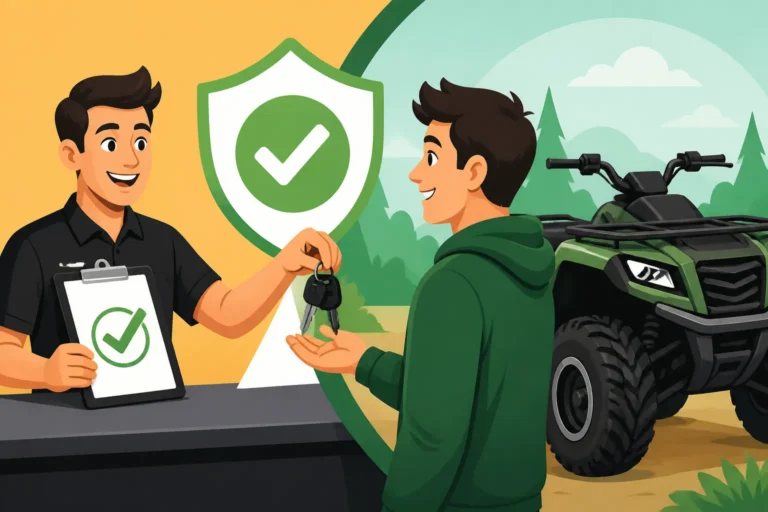
Once your transaction is complete, the ServiceOntario representative will issue you a brand new Ontario Vehicle Permit. This permit will now bear your name as the registered owner, effectively making the machine legally yours. It’s a vital document that you must keep safe and accessible, as you're required to carry it (or a true copy) whenever you operate your off-road vehicle. This new permit replaces the previous owner’s green slip and is your official proof of ownership and registration.
In addition to the permit, you'll also receive an Ontario ORV licence plate. Unlike car plates, ORV plates are generally issued at the time of registration and are specific to the machine, not necessarily the owner, though the permit ties it to you. If the previous owner's plate was being transferred, it would have been recorded, but often a new plate is issued. This plate must be properly affixed to your ATV or UTV before you ride. ServiceOntario will provide temporary documentation, usually a small sticker or paper slip, that serves as interim proof of registration until you receive your physical plate in the mail, or if you receive the plate directly at the counter. For precise guidelines on where and how to mount your new plate, refer to [Ontario ORV Plates and Where They Mount]. Ensure it's visible and securely attached to prevent loss or damage on the trails.
What to Do Next: Insurance and Safe Riding
With your new permit and plate in hand, you're almost ready to ride, but there's one more non-negotiable step: ensuring you have valid insurance. In Ontario, mandatory liability insurance is a legal requirement for any off-road vehicle operated anywhere off private property. Even if you only plan to ride on private land, comprehensive insurance is highly advisable to protect yourself from unforeseen circumstances. It's smart to have your insurance policy active before you even complete the registration, but confirm everything is in order once your machine is officially in your name. Your insurance provider will need your new permit and plate details to finalize your coverage. Review [Ontario ATV Insurance Requirements] to fully understand what coverage you need.
Finally, while the legalities are behind you, remember that safe and responsible riding is paramount. Familiarize yourself with Ontario's off-road vehicle laws, including age restrictions, helmet requirements, and where you are legally allowed to ride. Always carry your updated Ontario Vehicle Permit and proof of insurance with you when riding. Consider joining an organization like the OFATV (Ontario Federation of ATV Clubs) for trail access and resources. By understanding your responsibilities as a new owner and prioritizing safety, you'll be able to enjoy countless adventures on your newly registered ATV or UTV across Ontario.
Here's a quick summary of the key documents and actions involved:
| Step | Description | Required Documents/Actions | Where to Go/Who to Contact |
|---|---|---|---|
| 1. Purchase | Acquire the ATV/UTV from the seller. | – Negotiate price | Seller / Buyer |
| 2. Documentation | Obtain all necessary papers from the seller. | – Original Ontario Vehicle Permit (green slip) | Seller |
| – Comprehensive Bill of Sale (LawDepot for templates) | Seller | ||
| 3. Prepare for Reg. | Gather your personal and vehicle information. | – Your valid ID (e.g., Driver's Licence) | Buyer |
| – Proof of insurance | Your Insurer | ||
| – Funds for fees & tax | Buyer | ||
| 4. Register | Visit ServiceOntario to transfer ownership and pay taxes. | – All documents from Step 2 & 3 | [Registering an ORV at a ServiceOntario Centre] |
| – Pay 13% RST ([13 Percent RST on an Ontario ATV]) | ServiceOntario | ||
| 5. Receive & Attach | Get your new permit and plate, then affix the plate. | – New Ontario Vehicle Permit | ServiceOntario |
| – New ORV licence plate | ServiceOntario | ||
| – Attach plate properly ([Ontario ORV Plates and Where They Mount]) | Buyer |
Disclaimer
This article is for general informational purposes only and does not constitute professional advice. Laws, prices and regulations vary by location and change over time. Consult a qualified professional for guidance on your specific situation.