Ontario’s $195 Annual
An annual trail permit can look like a simple $195 purchase, but the useful question is what it actually lets you ride, for how long, and whether it covers every trail on your route. This guide explains how to think about the annual permit, how it differs from vehicle registration, and what to check before buying or riding across a club boundary.
What the $195 annual permit means
The $195 in the title is a reference point for an Ontario annual ATV trail permit, not a price to assume is still current. Permit fees can change, and the final amount may depend on the permit type or purchase options. Check the permit seller’s current information before you buy.
An annual trail permit is generally associated with access to participating off-road vehicle trails. It is not the same as registering your quad or UTV with the province. Vehicle registration gives you a permit and plate for the machine; a trail permit is about permission to use particular trail networks under their rules. If you need the provincial registration process, see Registering an ATV in Ontario.
That distinction matters because one permit does not replace the other. A trail permit does not register an unregistered machine, and a provincial plate does not automatically give you access to club trails. The provincial one-time registration charge is explained in Ontario’s One-Time ORV Permit.
Annual trail permits are often described as lasting 365 days from purchase. That can make the purchase date important: buying well before your first ride may mean part of the permit period passes before you use it. Confirm the validity dates and any rules for your specific permit when you check out. For a closer look at timing, see Buying an OFATV Permit to Get a Full Year.
The annual option is most useful for riders who expect to use participating trails more than once or twice. It can simplify planning: instead of arranging a short-term pass for each outing, you have a permit for the relevant period. But “annual” does not mean unlimited access everywhere in Ontario. Trail closures, local passes, club rules and land restrictions still apply.
Before paying, make sure the permit matches:
- The machine you plan to ride
- The network or club area on your route
- Your expected riding dates
- Any additional pass required by a local trail operator
- The permit’s display or proof-of-purchase rules
If the listing or checkout page is unclear about what is included, pause and ask the seller or relevant club. A quick check is easier than discovering at a trailhead that the permit you bought does not cover that section.
What it covers, and what it does not
An annual permit can provide access to participating trails, but the coverage depends on the permit and the organizations that accept it. Even where a larger network recognizes the permit, individual trail operators may have additional requirements. A route that crosses several club areas deserves a little research before you leave home.
| What you are checking | What an annual permit may do | What to confirm |
|---|---|---|
| Participating club trails | Provide access during the permit’s valid period | Whether each club on your route accepts it |
| Local trail systems | May be accepted, or may be one part of the access requirement | Whether a separate club or land-use pass is needed |
| Vehicle registration | Does not replace provincial registration | That your machine has its required permit and plate |
| Insurance | Does not serve as proof of insurance | What insurance your riding location and activity require |
| Trail closures | Does not open a closed trail | Current conditions, seasonal closures and posted restrictions |
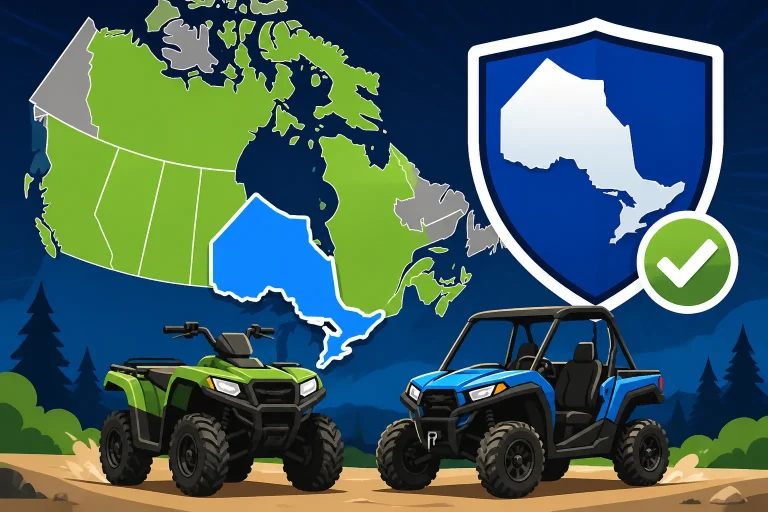
| Riding outside Ontario | May be recognized by some jurisdictions | Whether the destination accepts it and what local rules apply |
A permit is only useful on trails where it is accepted and riding is allowed. A seasonal closure, a temporary work closure or a sign restricting access can override your expectation that a valid annual permit is enough. Check local trail notices shortly before riding, not just when you purchase the pass.
Also check whether your trip crosses from one organization’s trails to another’s. Ontario’s trail system is not a single uninterrupted route with one universal access rule. A permit accepted in one area may not satisfy another operator’s requirements. Ontario’s Separate Club Passes explains why a rider may encounter more than one pass requirement.
Some well-known areas have their own arrangements. Ganaraska Forest access, for example, involves forest-specific requirements, and riders should check the current entry and parking rules directly before travelling. Haliburton riders should confirm whether a local pass is needed in addition to their broader trail permit; the distinction is covered in Why Haliburton Riders Need a HATVA Pass Too. For routes involving the Eastern Ontario Trails Alliance, check its access requirements rather than assuming that an annual permit covers every trail.
A useful habit is to map your route by trail operator, not just by town or region. If the route passes through more than one network, list each one and verify the permit it accepts. The question is not simply “Do I have an annual?” but “Does this annual cover every trail section I plan to ride?” Does Your Permit Cover the Next Club’s District? is a helpful next read.
How to decide whether an annual is worthwhile
The annual permit’s value depends on how often you ride and where you ride. A rider planning several outings on covered trails may prefer one annual purchase to arranging short-term access each time. A visitor planning a single weekend, or someone whose usual destination requires a separate local pass, may find that a different option fits better.
Rather than relying on a rule of thumb, compare the current permit options against your actual plans:
- Write down the number of trips you expect to make during the permit period.
- Identify the trail systems you are likely to use.
- Check which pass each system accepts.
- Compare the total cost of the annual option with the short-term options available for those trips.
- Include any extra club, forest, parking or land-use fees that apply.
- Check the permit’s start date and expiry before completing the purchase.
Use the current rates from the seller for that comparison. Short-term options and annual pricing can change, so an old calculation may no longer be useful. The OFATV Permit and What It Costs in Ontario gives more context about the permit structure, while [Ontario ATV Day Permit Cost] and Ontario ATV Three-Day Permit Cost can help if you are comparing a brief visit with longer-term riding.
Think about how flexible your plans are, too. If you tend to visit different regions, an annual permit may be convenient only if the areas you actually ride accept it. If you usually return to one local system, a local pass could be more relevant. If you are visiting from out of province, check whether the destination recognizes your home permit before buying an Ontario annual. Do not assume that reciprocity applies just because two provinces have trail organizations.
The permit may also support trail operations, but that does not mean every dollar goes to the club you ride most. Permit revenue can be distributed among participating organizations and related program costs. The distribution model is covered in 75 Percent to Your Chosen Club. If supporting a particular trail area is part of your decision, check how the permit system handles club selection and funding.
Finally, compare the annual trail permit only with other trail-access options. Do not count provincial registration or insurance as interchangeable costs. Those are separate obligations, and an annual trail permit does not take their place.
Reciprocity outside Ontario
“Reciprocity” means one jurisdiction recognizes a permit issued by another, but it should not be treated as a blanket promise. Recognition can depend on the province, the trail network, the type of permit, and the conditions attached to it. It is also separate from the rules for registering your machine, carrying insurance, and riding on roads.
Before taking an Ontario permit across a provincial border, verify three things:
- The destination recognizes the specific permit you hold.
- Your intended trails are included in that recognition.
- You meet the destination’s separate registration, insurance and riding requirements.
Do this with the trail organization or authority responsible for the destination, rather than relying only on a friend’s past experience. Agreements can change, and even a valid reciprocal permit may not cover a special-use area or independently operated trail.
Quebec deserves particular attention because riders may remember an older agreement that no longer applies. Check the current rules before planning a Quebec ride; Why the Quebec Agreement Ended in 2023 explains the background. If you need access there, confirm what permit is required from the relevant Quebec organization.
Some Maritime destinations may recognize an Ontario permit under their own conditions. That recognition is not a substitute for checking the specific province and trail system. For details to verify, see Ontario Permits Honoured in New Brunswick, Ontario Permits Honoured in Prince Edward Island and Ontario Permits Honoured in Nova Scotia.
Registration is another separate issue when you travel. A trail permit is not a licence plate, and recognition of a trail permit does not automatically settle whether your machine’s Ontario registration is acceptable where you are going. If you are riding across a border, review both the trail-access conditions and the vehicle rules before departure.
Buying, carrying and checking your permit
Buy from the appropriate permit seller and read the listing carefully before checkout. Confirm the permit type, the validity period, what machine or rider it applies to, and whether any local pass is additional. Keep the order confirmation and note how the permit is meant to be shown. If the transaction offers a club or network choice, make sure it matches your riding plans.
Follow the instructions for displaying the permit sticker, if one is issued. A sticker that is missing, covered in mud or mounted where it cannot be seen may cause a problem even if the purchase itself is valid. What an OFATV Trail Permit Sticker Looks Like and Where the Sticker Goes can help with the practical details. Do not put a sticker somewhere that hides required vehicle information or makes it likely to peel off during normal riding.
If the permit provider allows digital proof, check exactly what counts. A confirmation email may be useful for your records, but do not assume that an email, screenshot or phone display replaces a required sticker. The rules for phone proof are discussed in Showing a Permit on a Phone. Download or save any permitted digital documents before heading into an area with poor service.
A few small items can make it easier to keep documents and devices usable on a wet or dusty ride. Some riders look on Amazon for a clear weather-resistant sleeve to protect paper documents, but the sleeve must not obscure a required sticker. Others compare phone mounts on Amazon for navigation; a mount does not make a phone an accepted substitute for permit display. A compact waterproof pouch from Amazon can also help keep a phone or confirmation details dry, but it is still worth carrying any required physical permit. These are convenience items, not official permit products.
Before setting out, use this quick checklist:
- The annual permit is valid on your ride date.
- The permit is attached to or associated with the correct machine, as required.
- Your route’s clubs and trail operators accept it.
- Any separate local pass or parking pass is arranged.
- The sticker or other proof is displayed in the required way.
- Your provincial registration and plate are in order.
- You have checked insurance requirements for your planned riding.
- You have reviewed current closures, conditions and local restrictions.
- If crossing a border, you have confirmed reciprocity directly with the destination.
If your plans change, recheck access. A route that was covered when you bought the annual can still involve a closure, a new local rule or a trail operator with separate requirements. Keep the permit details handy, but treat it as one part of your ride preparation—not as permission to ride every trail in Ontario.
Disclaimer
This article is for general informational purposes only and does not constitute professional advice. Laws, prices and regulations vary by location and change over time. Consult a qualified professional for guidance on your specific situation.