Ready To RideON and Its Six Modules
Ready To RideON can help Ontario ATV and UTV riders build safer habits, but it is easy to mistake training for a licence or trail pass. The course’s six modules are useful preparation, not a substitute for understanding the rules that apply to your machine, route and age. Here’s what to expect and how to use the training.
What Ready To RideON Is—and What It Is For
Ready To RideON is an online off-road vehicle safety training program for Ontario riders. It is designed to help people understand safer operating practices before they ride, whether they are new to ATVs and UTVs or need a structured refresher.
The program is organized into six modules and is commonly described as taking about two hours to complete. Treat that as a planning estimate rather than a promise: your pace, the material presented and any knowledge checks can affect how long you spend. Check the program itself for current details about access, completion records and any charges.
The course is especially useful for newer riders, young people learning with an adult, and families who want to discuss safety before a machine is started. It gives everyone a shared foundation for conversations about protective gear, inspections, control, terrain and responsible decisions. A parent or experienced rider can also work through the material alongside a new operator and connect each lesson to the specific machine the rider will use.
The main benefit is preparation. A rider who understands the ideas behind a safe start, a controlled stop and a route decision is in a better position to practise those skills under supervision. Online learning, however, cannot show whether someone can actually handle a machine. It does not assess a rider’s balance, judgment, ability to react to changing ground or readiness for a particular vehicle.
For more context on the role of training in Ontario, see Ontario Rider Training and Why It Is Voluntary and Is an ATV Safety Course Required in Ontario?. The important distinction is that a useful safety course and a legal prerequisite are not always the same thing. Completing a course should not be taken as permission to ride wherever or however you choose.
Who may benefit most
A beginner can use the course to learn basic concepts before practising in a suitable, controlled setting. A parent can use it to guide a conversation with a teenager, rather than relying on a quick explanation at the trailhead. An experienced rider may also find it valuable as a check against habits that have become automatic.
It can be particularly helpful when a household has more than one type of off-road vehicle. ATV and UTV operation share some safety principles, but the machines differ in how they are controlled and how they protect occupants. A side-by-side’s seat belts and occupant-protection features, for example, do not make it safe to ignore speed, terrain or passenger rules.
Training is only one part of a sound preparation plan. Before a ride, operators should also know the machine’s manual, check that it is suitable for the intended route, inspect its condition and confirm that they are allowed to ride on the land or trail.
What the Six Modules Help Riders Understand
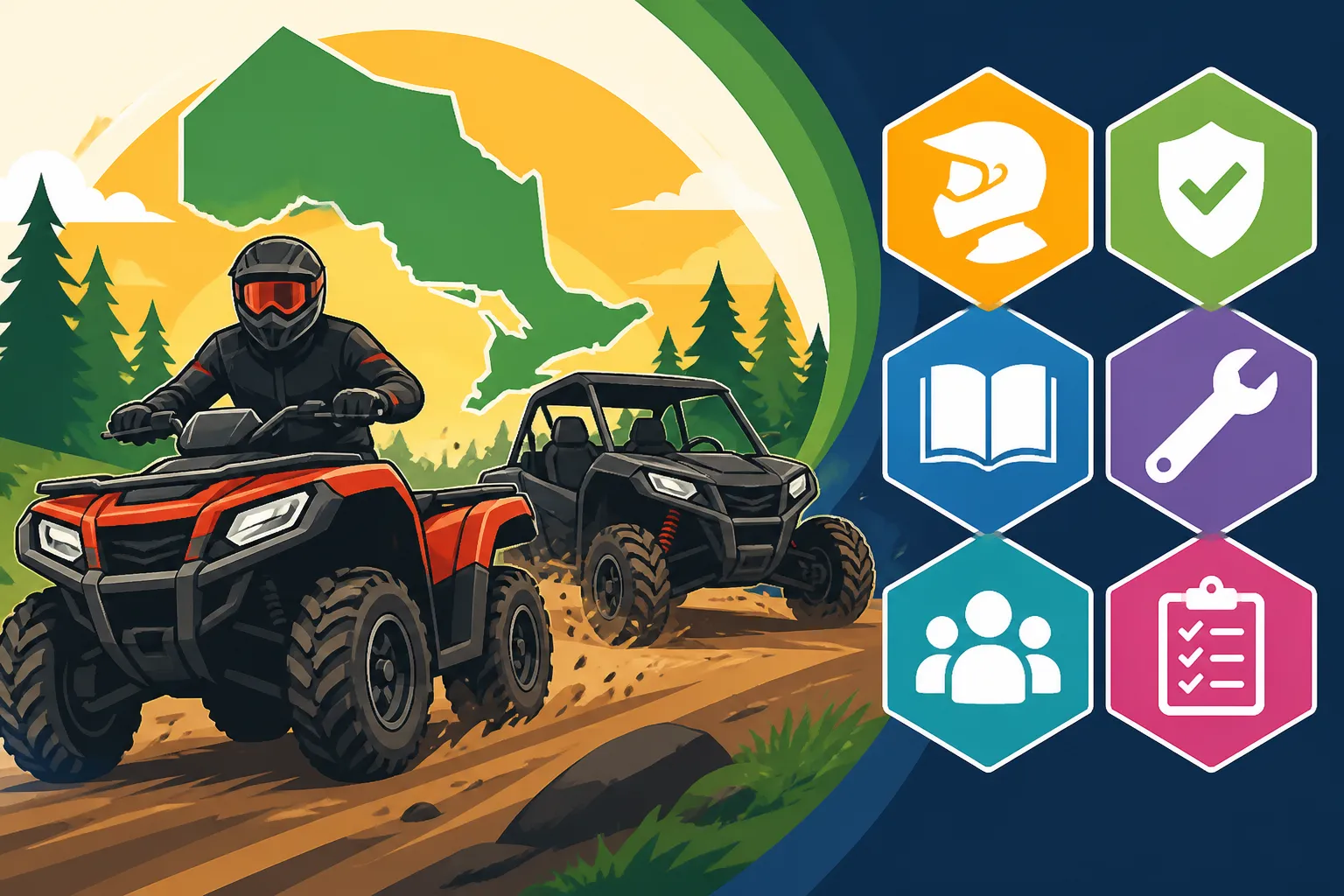
The six modules are best treated as parts of one safety foundation, rather than six boxes that automatically make someone an experienced operator. The points below describe the kinds of skills and decisions riders should look for in a structured ATV and UTV safety course. They are a practical way to understand the learning, not a claim that these are the program’s official module titles. Follow the current course for its exact sequence, lesson names and activities.
-
Know the machine. Riders need to understand that an ATV or UTV is not a car and should not be handled like one. Learn the controls, read the operator’s manual and know the machine’s limits, passenger capacity and intended use. A vehicle’s size or power does not establish that it is suitable for a particular rider.
-
Choose and use protective equipment. A safe ride starts before the engine is running. Riders should understand why a properly fitted helmet and other suitable protective gear matter, and why equipment needs to be in good condition. Clothing and gear should suit the weather and terrain without interfering with controls or visibility.
-
Inspect before riding. A walk-around can help identify obvious problems before they become trail hazards. Check that key parts appear secure and serviceable, that tires are in usable condition, and that controls, lights and other required equipment work as intended. The machine’s manual is the right reference for its specific inspection and maintenance points.
-
Practise control and riding technique. Riders need to learn how to start, stop, steer and manage speed smoothly. A technique that works on flat, predictable ground may not be safe on a slope, in loose material or around an obstacle. Practise should begin in an appropriate open area, at a manageable pace, with supervision matched to the rider’s ability.
-
Read terrain and make route decisions. Safe operation includes knowing when not to proceed. Mud, ruts, steep grades, water, poor visibility and changing trail conditions can all affect control. Riders should be able to identify hazards, leave room to stop and turn back when conditions exceed their skills or the machine’s capabilities.
-
Ride responsibly around other people and the environment. A safe operator respects passengers, other trail users, landowners and posted restrictions. Staying on an authorized route, controlling noise and speed, and avoiding damage to land are practical parts of responsible riding—not optional extras after the technical skills are learned.
The value of these themes is in applying them. For instance, knowing that water crossings can be hazardous is useful; deciding not to enter a crossing when depth or current cannot be judged is the safer action. Likewise, understanding that passengers affect how a machine handles should lead to checking the vehicle’s passenger capacity and following the rules for that machine.
Young riders often need extra time to turn classroom ideas into safe habits. Training should be paired with appropriate supervision and a machine that fits the operator. See Ontario ATV Training for Young Riders, Ontario Supervision Rules for Minors and Teaching a Child to Ride Safely for related considerations.
What Completion Does Not Replace
Ready To RideON is safety education. It is not an Ontario driver’s licence, an off-road vehicle registration permit, proof of insurance or permission to use a trail. It also does not grant permission to cross private land or ride on a road that is closed to off-road vehicles.
That distinction matters because riders often use the word “permit” to mean several different things. In Ontario, registration documents and a plate relate to the machine’s registration. Insurance addresses liability coverage. A trail permit or pass may be needed for a particular organized trail network. These serve different purposes, and course completion does not substitute for any of them.
| What the rider needs | What it addresses | Does Ready To RideON replace it? |
|---|---|---|
| Safety training | Knowledge and safer decision-making | No. The course is training itself, not a substitute for practice or judgment. |
| Vehicle registration | Registration requirements for the machine | No |
| Liability insurance | Financial responsibility and insurance requirements | No |
| Trail access permission or permit | Access to a particular trail network or property | No |
| Road-use requirements | Whether and how a machine may use an eligible road | No |
Before using an ATV or UTV, check the requirements that apply to the machine and where it will be ridden. Registration is separate from trail access; The Ontario Vehicle Permit Explained outlines what a vehicle permit is, while Ontario ATV Insurance Requirements covers the insurance side. For trail access, start with the rules of the relevant club, land manager or property owner. Ontario ATV Trail Permits Explained can help clarify why a trail pass is a separate question.
Training does not determine where a machine may go
A course can teach a rider to recognize hazards, but it cannot open a road or trail. Ontario road access depends on the applicable provincial rules and local restrictions, as well as whether the machine and operator meet the conditions for that road. An open route in one municipality does not mean the next municipality has the same rule. Check the specific route and local by-law before riding.
The same practical caution applies to off-road trails. A trail may be closed seasonally, restricted to certain users or accessible only with a particular pass. Riders should verify current access instead of assuming that a familiar route is still open. If riding on private land, get permission from the landowner; completing a course does not change property rights.
Training is not a legal age or licence exception
A course completion record cannot override age, supervision or licensing requirements. The rules can differ depending on whether someone is riding off-road or on an eligible road, and the rider’s age and machine type matter. A parent should check the specific conditions before allowing a young person to operate.
For related information, see Ontario ATV Minimum Age Off-Road and Ontario ATV Licence Requirements. Do not assume that finishing an online course makes a young rider eligible for every machine or riding situation. Training can support safe learning, but it does not replace a required licence, an age threshold or supervision.
Training does not create cross-border reciprocity
Ready To RideON is not a trail permit and does not establish that a pass or qualification will be accepted outside Ontario. When planning a ride in another province or jurisdiction, check the destination’s registration, insurance, trail-access and operator rules directly. A course can give a rider useful safety knowledge, but the other jurisdiction decides what it recognizes and what riders must carry.
That is especially important for a trip that crosses from one club network or province to another. Confirm which pass covers each trail segment and whether the rider must meet additional local requirements. Do this before setting off, not after reaching a trailhead.
How to Get More Value from the Course
An online course is most useful when riders turn its lessons into a simple routine. Completing the modules in one sitting may be convenient, but a family may get more from pausing to discuss how each point applies to its own machine, equipment and riding plans.
-
Set aside focused time. Choose a place where the rider can pay attention and complete the lessons without rushing. If the course includes checks or review questions, treat them as a way to notice gaps, not as a race to finish.
-
Have the machine’s manual available. Compare general safety advice with the instructions for the specific ATV or UTV. Controls, capacity, maintenance points and operating limits can vary between machines.
-
Talk through realistic situations. Ask what the rider would do if a trail became muddy, visibility dropped or a group became separated. These discussions help turn general safety ideas into decisions a rider can use.
-
Pair learning with supervised practice. Begin in a suitable, legal area with ample room and manageable conditions. Practise basic control before introducing more difficult terrain. A course cannot confirm that a rider is ready for a challenging route.
-
Review before a change in riding conditions. A move from a small ATV to a larger one, a switch to a UTV, or a first trip on unfamiliar trails all call for renewed preparation. Familiarity with one machine does not automatically transfer to another.
-
Keep the completion record if the program provides one. It can be useful for personal records or family discussions. Do not present it as proof of registration, insurance, a licence or trail access unless a specific organization has expressly said it accepts that record for a particular purpose.
Parents and guardians can make the training more meaningful by asking the young rider to explain the reasons behind a safety choice. “What would you check before starting?” is more useful than asking only whether the course is finished. A rider who can explain why a decision matters is more likely to recognize when conditions have changed.
For operators who have ridden for years, the same approach can uncover assumptions. A familiar trail may be different after rain or seasonal damage. A second passenger may change the machine’s handling. A route that was legal last season may now be closed. Safety training works best when it supports active decisions rather than a one-time checkmark.
Before You Ride: A Practical Checklist
Use the course as the learning component of a broader pre-ride check. The details vary by machine and trip, but these questions help catch common oversights:
- Is the operator ready for this machine? Consider age, experience, physical ability and whether the rider can reach and operate the controls.
- Is the machine suitable and maintained? Use its manual, check its condition and confirm that it is configured for the intended number of occupants.
- Is the protective equipment appropriate? Check fit and condition, and make sure it does not compromise visibility or control.
- Is the route authorized and open? Confirm landowner permission, local restrictions, trail access rules and seasonal closures.
- Are the required documents and coverage in order? Confirm registration, insurance and any trail pass that applies to the planned ride.
- Does everyone understand the plan? Agree on pace, stopping points, communication and what to do if the group becomes separated.
- Can the ride be shortened or cancelled? Poor weather, fatigue, mechanical concerns or difficult conditions are sound reasons to change plans.
For trail rides, plan around the specific network rather than relying on general assumptions about Ontario access. A permit associated with one organization may not cover every nearby trail. Check the pass and route details with the relevant club or operator. For public-road use, confirm that both the road and the machine qualify before entering it.
Ready To RideON is therefore best understood as one useful layer of preparation. It can help riders build a safety vocabulary and think through decisions before they are under pressure. Its six modules are not a licence, a registration document or a universal trail pass, and they do not prove that someone is ready for every ATV or UTV. Combine the course with machine-specific practice, current local rules and conservative judgment.
Frequently Asked Questions
Is Ready To RideON mandatory in Ontario?
Ready To RideON is voluntary safety training, not a general legal prerequisite for operating every ATV or UTV in Ontario. Separate age, supervision, licence, registration, insurance and road-use rules may still apply. Check the rules for the exact riding situation.
How long does the course take?
The course is commonly described as taking about two hours. Your time may vary depending on your pace and how you work through the lessons. Check the program for its current estimate and completion details.
Does completing the course give me a trail permit?
No. Course completion does not grant access to an ATV or UTV trail network. Check with the club, land manager or property owner for applicable passes and access conditions.
Does the course replace hands-on practice?
No. Online learning can introduce safety concepts, but it cannot assess how well someone controls a machine. Pair the material with suitable supervised practice and the manufacturer’s operating instructions.
Will another province accept the course as proof of training?
Do not assume so. Ready To RideON does not itself create cross-border recognition. Check the destination’s requirements for riders, vehicles, insurance and trails before travelling.
Disclaimer
This article is for general informational purposes only and does not constitute professional advice. Laws, prices and regulations vary by location and change over time. Consult a qualified professional for guidance on your specific situation.