Ontario ATV Training for Young Riders
A young rider may be eager to get on an ATV, but buying a machine or completing an online course does not automatically make every ride legal or safe. Ontario families need to consider the child’s age, where the ATV will be used, the machine’s fit and the supervision available. Here’s how training can help, what it does not replace, and how to set up a safer first ride.
What training can—and cannot—do
Ontario does not generally require every ATV rider to complete a safety course before riding. That does not make training pointless. Young riders are still learning how quickly a machine responds, how terrain changes its handling, and how to make safe decisions when they feel unsure. Structured instruction can provide a useful starting point for those skills.
One option is Ready To RideON, a voluntary online learning program. It is designed to introduce riders to off-road vehicle safety and is organized into six modules. The course can give a young rider and parent or guardian a shared set of topics to discuss before heading out. Check the program’s official page for current access details and any costs.
An online course is best treated as preparation, not hands-on qualification. It cannot show whether a child can control a particular ATV, judge a slope, use the brakes smoothly, or react appropriately when the machine begins to slide. A completion record is not a road licence, a trail permit, proof of insurance, or permission to operate a machine where the law or property rules do not allow it.
For a general overview of the course requirement, see Is an ATV Safety Course Required in Ontario?. To understand the online program’s structure, Ready To RideON and Its Six Modules provides more detail.
A useful training plan combines three things:
- Learning before the ride. Cover basic controls, protective equipment, terrain hazards, and what to do if the rider becomes uncomfortable.
- Practice in a suitable place. Begin on level, open ground with permission to ride there, away from traffic, water, steep slopes, and obstacles.
- Ongoing supervision. Stay close enough to observe, communicate, and stop the ride if the young rider is tired, overwhelmed, or taking risks.
A course can help with the first step. It cannot replace the other two.
Check age, location, and supervision first
Before choosing a course or ATV, find out where the child will ride. Ontario requirements can differ between private property, public land, trails, and roads. A child’s age, whether an adult is supervising, and the type of riding area can all matter.
In general, children under 12 face restrictions on operating an ATV away from private property, with limited exceptions that depend on the situation and supervision. Do not assume that a child who can ride on a family property can also ride on a public trail. For the details, see Ontario ATV Minimum Age Off-Road and Ontario Supervision Rules for Minors.
Public-road riding is a separate issue, with additional age, licence, machine, equipment, insurance, and road-access rules. A youth who is allowed to ride off-road is not automatically allowed to ride on a road. Before any road use, check Ontario ATV Licence Requirements and confirm whether the particular road is open to ATVs.
A course does not override these rules. Nor does an adult’s presence automatically make every ride permissible. The supervising adult should check the applicable law, trail rules, and landowner conditions before the child starts the machine.
Match the rules to the riding place
Use this table as a planning prompt, not as a substitute for checking the rules that apply to the specific property or trail.
| Riding location | What to check before the ride | Training consideration |
|---|---|---|
| Private property | Landowner permission, property hazards, and any age or supervision requirements | Start in a clear, controlled area; keep the first practice session short |
| Public land or an organized trail | Minimum-age and supervision rules, access restrictions, trail conditions, and permit requirements | Teach the child to follow signs, stay on the marked route, and stop when unsure |
| Municipal road | Whether ATVs are permitted on that road and the rider, machine, insurance, and equipment requirements | Do not use public-road riding as a beginner’s practice session |
| A rental or guided ride | The operator’s minimum age, driver rules, passenger rules, and safety briefing | Follow the operator’s instructions; a tour’s rules may be stricter than the general law |
Private property is not a blanket exemption from safe riding practices or every legal requirement. Confirm that the person giving permission has authority over the land, and make sure the riding area is appropriate for the child and machine. Ontario ATV Rules for Riding Private Property can help with that distinction.
A public trail also brings considerations beyond the rider’s basic control of the ATV. Trails may be narrow, uneven, shared with other users, or closed because of weather or maintenance. A young rider needs to understand that a trail marker or closure sign is an instruction, not a suggestion. Parents should check the route and conditions in advance and avoid assuming that an adult’s trail permit covers every location or club area.
Teach practical skills before a longer ride
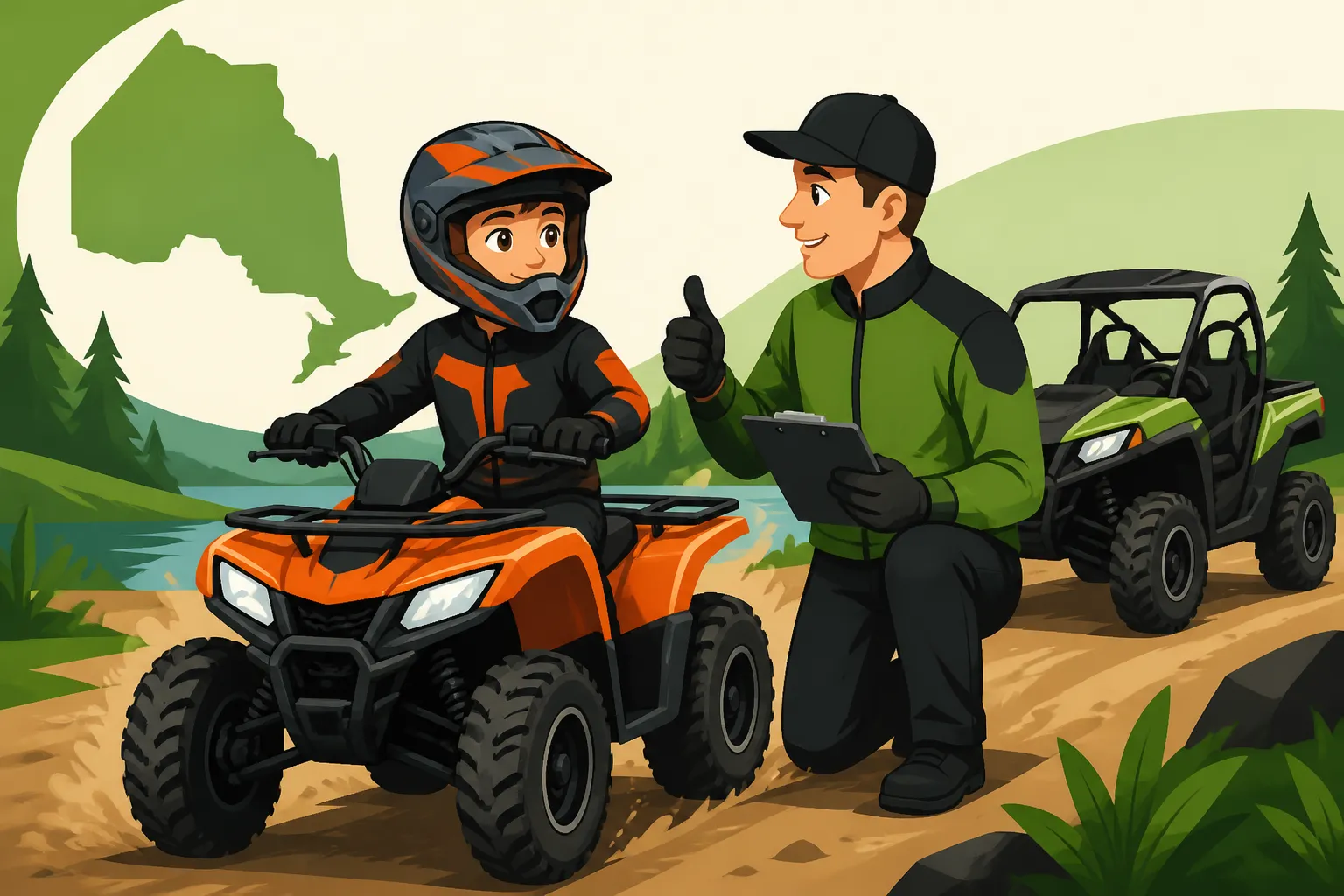
Good training starts with the machine parked and switched off. Ask the young rider to identify the controls, explain how the brakes work, and point out the engine stop control. Review how to get on and off safely, where to keep hands and feet, and what to do if the ATV stalls. The child should be able to explain the basics in their own words before moving on to practice.
Next, check whether the machine is an appropriate size and type for the rider. Being able to sit on the seat does not prove that a child can control the ATV. The rider needs to reach and operate the controls comfortably, move their weight as needed, and keep a secure position without stretching or losing balance. Follow the manufacturer’s guidance on rider age, capacity, and use. An adult-sized or powerful machine can be difficult to manage even for a child who is confident on a smaller one.
Start with simple movements on flat, open ground:
- Practice starting and stopping smoothly.
- Ride at a walking pace and make wide, controlled turns.
- Practice looking where the ATV is going rather than staring at the front wheels.
- Stop, get off, and walk the area before practising a new manoeuvre.
- Introduce gentle changes in terrain only after the rider can control the machine on level ground.
Do not turn a first practice session into a speed test. The goal is consistent control, not covering distance. Keep the session short enough that the child can stay attentive. Fatigue, frustration, peer pressure, or excitement can quickly undermine good decisions.
Before riding, fit protective equipment. A properly fitting helmet designed for off-road motorized riding is essential; check the rules for the place where the ride will happen and make sure the helmet meets the applicable standard. Goggles or eye protection, gloves, long sleeves, long pants, and sturdy footwear that covers the ankles help protect against debris, branches, and contact with the machine. Equipment should fit the rider rather than be borrowed in an oversized adult size.
Teach a simple stop-and-check routine. The child should stop if they cannot see the route clearly, are unsure how to cross an obstacle, feel uncomfortable, or lose sight of the supervising adult. They should not try to follow a faster rider just to keep up. Agree on a clear signal for stopping and make sure the child knows what to do if separated from the group.
For riding with family or friends, explain passenger limits too. A machine designed for one rider must not be treated as a two-person vehicle. Even on a machine made for a passenger, the child must be able to sit securely and follow the passenger rules for the location. See Ontario ATV Passenger Rules before carrying anyone.
Build a safer plan for a young rider
Parents and guardians can make training more effective by treating it as an ongoing process. A child who has completed an online module still needs practice, close observation, and clear limits. Skills that seem reliable on a flat field may not transfer to mud, loose gravel, hills, or a crowded trail.
Before each ride, use a short checklist:
- Confirm permission and access. Check that the property or trail is open to riding and that the child is allowed to operate there.
- Check the rider and machine. Make sure the ATV suits the rider, is in good condition, and has no obvious leaks or damaged controls.
- Fit the protective gear. Check the helmet fastener, eye protection, footwear, and clothing.
- Set boundaries. Explain where the child may ride, where they must stop, and how close they need to stay to the supervising adult.
- Choose a realistic route. Avoid routes that exceed the child’s current ability or leave no easy way to stop and regroup.
- Agree on a stopping rule. The child should know that stopping to ask for help is always the right choice.
Supervision should be active. Watching from far away, riding ahead, or assuming an older child will manage because they have ridden before may not be enough. Stay in a position where you can communicate and respond. If the terrain, group pace, or weather changes, reassess rather than press on.
It also helps to talk about the decisions that happen between the controls: staying on the permitted route, respecting other trail users, not riding while distracted, and refusing to race. A young rider should know that following an adult’s direction is part of riding safely, even when the ATV feels easy to operate.
If the family is considering a course, think of it as one part of a larger plan. Ontario ATV Rules for a Twelve-Year-Old addresses age-specific questions, while Ontario ATV Safety Course Cost can help with the cost of formal training. Program details and prices can change, so confirm them directly before enrolling.
The most useful measure of readiness is not whether a young rider has finished a course or is eager to go farther. It is whether they can control the machine at an appropriate pace, follow instructions, recognize when conditions are beyond their ability, and stop without pressure. When any of those pieces is missing, keep the ride simpler and continue practising.
Disclaimer
This article is for general informational purposes only and does not constitute professional advice. Laws, prices and regulations vary by location and change over time. Consult a qualified professional for guidance on your specific situation.