Why Width Is Capped at 2.03 Metres
It can be incredibly frustrating to feel like you're navigating a maze of rules and regulations just to enjoy your off-road vehicle in Ontario, especially when it comes to riding on roads. One of the most common head-scratchers for riders, particularly those with side-by-sides, is the provincial cap on machine width at 2.03 metres. This guide is here to untangle that specific regulation, explain why it exists, and help you understand how it impacts your ability to legally hit the pavement.
Understanding Ontario's Off-Road Vehicle Classifications
Before we dive into the specific width limit, it's really important to grasp how Ontario classifies different off-road vehicles (ORVs). The province doesn't just see a "quad" or a "side-by-side" – it has specific legal definitions that dictate what you can and can't do with your machine, especially when it comes to road use. Missing these nuances can lead to fines, so let's break down the main categories that concern us here.
The ATV Class and Its Parameters
When the province talks about an "ATV," they're generally referring to what most of us picture: a traditional single-rider or two-up quad. These machines are defined by specific characteristics that set them apart from their wider cousins. For instance, an ATV typically has handlebars for steering, a seat designed to be straddled by the operator, and generally weighs less than many side-by-sides. Their design naturally keeps them within narrower dimensions, which historically made them more adaptable to certain road allowances or shoulders without presenting an undue hazard to other traffic.
Under [The ATV Class Under Ontario Regulation 316/03], these vehicles have specific design requirements that are intended to ensure their safe operation, both off-road and, where permitted, on provincial and municipal roadways. This class often brings with it certain expectations from law enforcement regarding how they are operated and what equipment they must carry. While ATVs are generally less likely to push the boundaries of the 2.03-metre width limit, it's still crucial for owners to be aware of their machine's exact specifications, especially if any aftermarket modifications have been made.
The ROV Class and Why Width Matters
The "ROV" class, or Recreational Off-Highway Vehicle, is where things get a bit more complex, particularly for side-by-side owners. This classification was introduced to accommodate the growing popularity of multi-passenger, utility-focused off-road vehicles that don't fit the traditional ATV definition. ROVs typically feature a steering wheel, side-by-side seating, and often a roll-over protective structure (ROPS) or roll cage, resembling a miniature utility vehicle more than a quad. These characteristics inherently make ROVs wider and often heavier than most ATVs.
It's within this ROV classification that the 2.03-metre width limit becomes particularly critical. Many newer, larger side-by-sides are designed with performance and stability in mind, leading to wider stances that can easily exceed this provincial threshold. This creates a real challenge for owners who want to use their ROVs on public roads, as even a slight overage can render their machine illegal for road use. Understanding [Ontario's ROV Class and Its Engine Cap] is vital, but the width dimension is arguably the most common hurdle for these machines.
How Engine Size and Weight Play a Role
Beyond width, Ontario's regulations also consider engine size and weight when classifying ORVs, though these typically affect road-worthiness less directly than the width limit. For example, some regulations might specify engine displacement caps for certain classes or minimum weights to differentiate between, say, a lightweight dirt bike and a heavy-duty side-by-side. While your machine's engine size might determine its horsepower and performance capabilities, it usually doesn't prevent it from being road-legal in the same way an excessive width measurement would.
Weight limits, particularly for the MPV (Multi-purpose Off-highway Vehicle) class, ensure that machines aren't excessively heavy for the types of roads they might traverse or the trails they're meant to share. For instance, [Ontario's MPV Class and Its Weight Limit] helps to classify larger, often more industrial-grade machines. However, for most recreational ATVs and ROVs, if your machine meets the width and other equipment requirements, its weight or engine size is less likely to be the single disqualifying factor for road use, unless it's an extreme outlier.
The 2.03-Metre Width Limit Explained
So, why 2.03 metres, you ask? It often feels like an arbitrary number, one that causes a lot of headaches for folks who just want to legally get from point A to point B or access a trail system. But there's a rationale behind it, and understanding that can help explain why it's so strictly enforced.
Why This Specific Measurement?
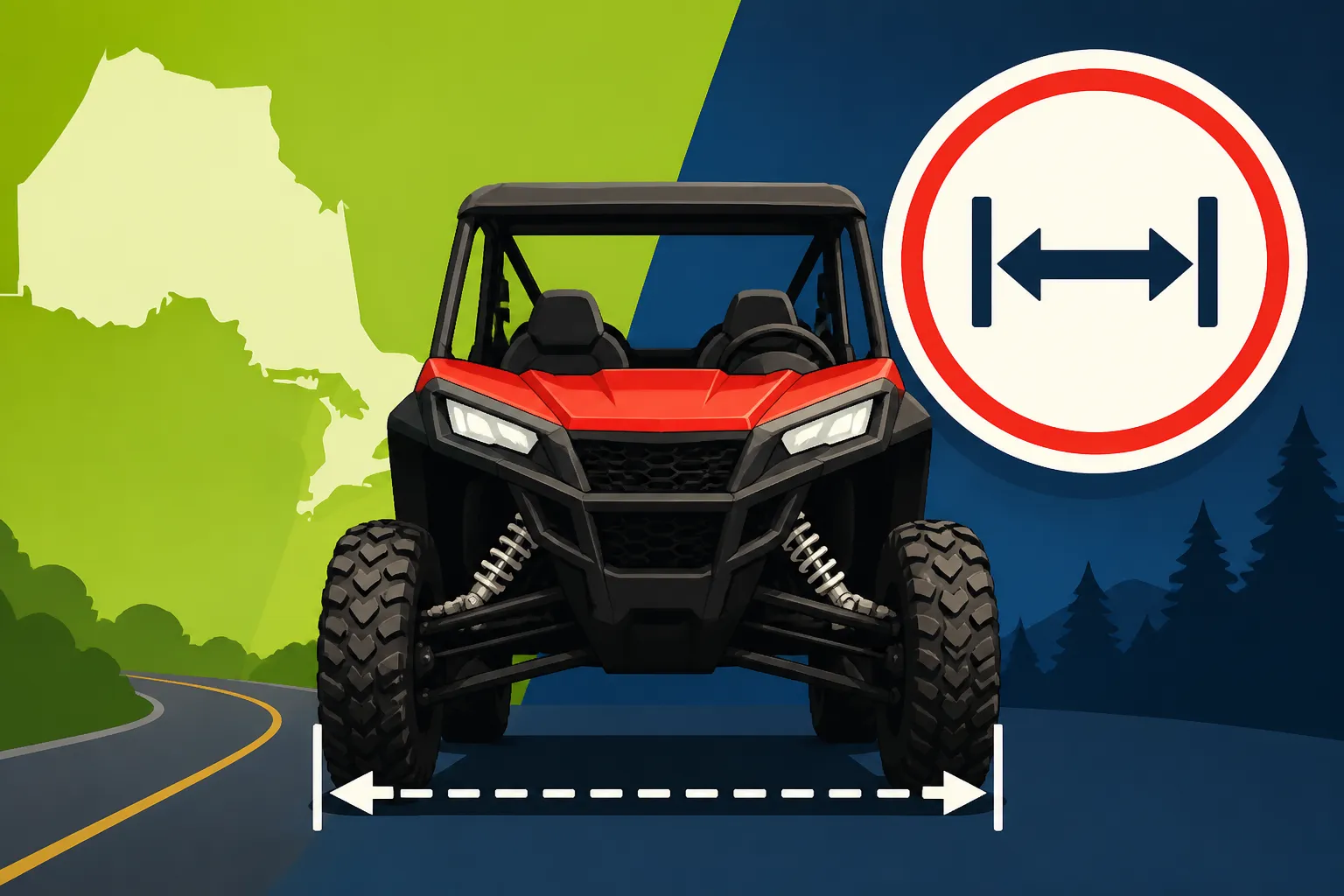
The 2.03-metre (or 80-inch) width limit isn't just pulled out of thin air. It's largely tied to road safety and the existing infrastructure of Ontario's roads and highways. Many public roads, especially older municipal and secondary routes, have lanes designed for standard passenger vehicles, which typically range from 2.0 to 2.5 metres wide (including mirrors). By setting a maximum width for ORVs, the province aims to ensure that these vehicles don't monopolize the lane, cross the centre line, or dangerously encroach on oncoming traffic or cyclists. Imagine a heavily trafficked rural road with a wide side-by-side taking up too much space – it creates a clear hazard.
Furthermore, this limit helps maintain a consistent standard for off-road vehicles sharing the road with cars, trucks, and even farm equipment. It's about predictability and reducing the risk of collisions. The limit also considers factors like shoulder widths, bridge clearances, and even the general footprint required to safely pass another vehicle or navigate tighter turns. It's a pragmatic measure designed to integrate ORVs into the existing road network as smoothly and safely as possible.
Implications for Side-by-Sides and Modified ATVs
This 2.03-metre width cap disproportionately affects side-by-sides (UTVs/ROVs) compared to traditional ATVs. Many modern side-by-sides, especially sportier or utility models with larger tires and wider stances, easily push past this boundary right off the showroom floor. If you own one of these machines, you need to be acutely aware of its exact width, because [A Machine Just Over 2.03 Metres Wide] cannot legally be operated on any public road in Ontario that has been opened to ORVs, regardless of whether it's a municipal road or a provincial highway segment.
The implications also extend to ATVs that have undergone aftermarket modifications. Adding wider offset wheels, wheel spacers, or certain suspension components can quickly push a standard ATV beyond its factory width, making it non-compliant for road use. It's common for riders to want to enhance stability or customize their machine's look, but these changes can have serious legal consequences if not carefully considered against the provincial regulations. Always measure after any modifications.
Practical Measurement Tips for Riders
Measuring your machine accurately is the first critical step to ensure compliance. You can't just eyeball it. The measurement needs to be taken from the widest points of your vehicle, which typically means the outer edges of your tires or fenders, whichever protrudes furthest. Don't forget any accessories like a snow plow mount or specialized racks if they extend beyond the main body of the machine.
Here's a simple way to get an accurate measurement:
- Park on level ground: Ensure your ORV is on a flat surface to get a true reading.
- Use a tape measure: A long, retractable tape measure works best.
- Find the widest point: Identify the outermost point on both sides of your ORV. This is usually the outside edge of your tires. If you have any accessories (like a brush guard or a fender flare) that extend wider than your tires, measure to those points instead.
- Measure across: Stretch the tape measure from the widest point on one side to the widest point on the other, ensuring the tape is perpendicular to the direction of travel.
- Double-check: Take the measurement a couple of times to ensure accuracy. Convert inches to metres if your tape measure is in imperial units (1 inch = 0.0254 metres).
It's a small but crucial step. If you're unsure, or if your measurement is close to the 2.03-metre limit, it's always best to err on the side of caution. Remember, an officer isn't going to give you a pass for "just a little bit" over the limit. [Measuring Your Machine Before a Road Ride] is non-negotiable.
Navigating Road Use Regulations with Width in Mind
Understanding the 2.03-metre width limit is one thing, but actually navigating the patchwork of road use regulations in Ontario with that in mind is another. It's not as simple as "my machine is legal, so I can ride anywhere." There are layers of rules, and your machine's width plays a central role in all of them.
Municipal By-laws and the Width Rule
While the province sets the overarching regulations for ORV classes and their dimensions, individual municipalities have the power to pass by-laws that permit or prohibit ORV use on their roads. This means that a road-legal ORV in one township might be illegal for road use just across the municipal boundary. Even if a municipality does open its roads to ORVs, your machine still has to comply with the provincial width limit, among other [Ontario ATV Rules on a Municipal Road]. A municipal by-law cannot override the provincial stipulation that your vehicle must be under 2.03 metres wide to be considered an eligible ORV for road use.
This creates a complex situation for riders. You might have a 60-inch (1.52m) wide side-by-side that meets all provincial requirements, but if the local municipality hasn't passed a by-law to open its roads, you still can't ride on them. Conversely, a municipality might have open roads, but if your side-by-side is 66 inches (1.68m) wide but has been modified with spacers to 82 inches (2.08m), it's simply too wide for any public road, even if the municipality welcomes ORVs. It's a two-tier compliance system you need to master.
Wider Machines on Designated Trails vs. Roads
This is where many riders get confused and frustrated. A wider machine that is not road-legal due to its width can still be perfectly legal and appropriate for off-road trail use. Organizations like the OFATV (Ontario Federation of ATV Clubs) maintain thousands of kilometres of trails across the province, and many of these trails are designed to accommodate a wider range of ORV sizes, including larger side-by-sides. You might have a beast of a machine, say, 70 inches (1.78m) or 72 inches (1.83m) wide, which is perfectly suited for conquering challenging terrain on a club trail.
However, the moment you attempt to transition that wider machine onto a public road that has been designated for ORV use, you hit a legal wall. The regulations for off-road trails and public roads are distinct, and the width limit is a prime example of this difference. This means you might need to trailer your wider side-by-side to a trailhead if you can't access it via legally open roads, or consider staging from private property directly adjacent to the trail. It's a crucial distinction for side-by-side owners to remember to avoid fines. For instance, [Ontario Side-by-Side Road Rules] are strict on this.
Consequences of Exceeding the Width Limit
Riding an ORV that exceeds the 2.03-metre width limit on an open road is not a minor infraction; it can lead to significant consequences. Law enforcement officers are trained to identify non-compliant vehicles, and a side-by-side that's visibly too wide will certainly draw attention. If you're caught, you could face hefty fines for operating an illegal vehicle on a highway. More importantly, if you're involved in an accident while operating an over-width machine, your insurance could be jeopardized, potentially leaving you personally liable for damages and injuries.
The risks aren't just legal or financial. Operating an over-width vehicle on roads designed for narrower traffic can increase the risk of collisions, especially in rural areas with tight turns, limited visibility, or shared road allowances. It's about safety, both for yourself and for other road users. Always prioritize compliance to protect yourself and others. If you're looking for [Ontario ATV Fines for Riding Without a Permit], remember that other infractions like exceeding width can also lead to similar penalties.
The Role of Aftermarket Accessories and Modifications
One of the great joys of owning an ORV is the ability to customize it to your heart's content, adding accessories or making modifications to improve performance, utility, or aesthetics. However, when it comes to riding on Ontario's roads, every modification needs to be carefully considered against the 2.03-metre width limit. What might be a fantastic upgrade for the trail could inadvertently render your machine illegal for road use.
Wider Tires and Wheel Spacers
One of the quickest ways to accidentally exceed the provincial width limit is by installing wider tires or wheel spacers. Wider tires, especially those with aggressive treads, can add a few inches to your overall width, which can be enough to push you over the 2.03-metre threshold, particularly if you have a side-by-side that was already close to the limit. Wheel spacers, designed to push your wheels further out from the hub for increased stability or a more aggressive stance, are almost guaranteed to make your machine wider.
While these modifications can offer improved handling and a beefier look on the trail, their impact on road legality cannot be ignored. Before installing new tires or spacers, always measure your vehicle's existing width and calculate the potential increase. Many reputable brands, like SuperATV, offer a vast array of aftermarket parts, including tires and suspension components. While these are top-quality products, it's the rider's responsibility to ensure that any installed parts keep their overall machine compliant with Ontario's road rules. Don't assume a part is road-legal just because it's available.
Lift Kits and Suspension Changes
Lift kits and other suspension modifications, while not directly increasing width, can sometimes be paired with wider tires or offset wheels, which do affect width. A lift kit raises the ground clearance of your ORV, which is fantastic for clearing obstacles on rugged trails. However, if that lift kit also necessitates a change to wider control arms or if you then choose to install larger, wider tires to fill out the lifted wheel wells, you could once again find yourself exceeding the 2.03-metre limit.
It's a domino effect: one modification can lead to another, and before you know it, your once road-legal machine is now restricted to private land or dedicated trail systems. Always consider the holistic impact of any suspension upgrade. Will it require new wheels or tires that push you over the edge? Discuss your road-use intentions with your mechanic or parts supplier before committing to significant suspension changes.
Staying Compliant While Customizing Your Ride
The good news is that you don't necessarily have to choose between customizing your ride and staying road-legal. It just requires careful planning and precise measurements. If road use is important to you, make the 2.03-metre limit a central factor in all your modification decisions.
- Research component dimensions: Before purchasing, check the width specifications of new tires, wheels, or suspension components.
- Measure constantly: After any modification, re-measure your ORV's total width from the widest points.
- Consult manufacturers/dealers: Reputable aftermarket parts providers, like SuperATV, or your local ORV dealer can often provide advice on how their products might affect your vehicle's dimensions and compliance.
- Prioritize compliance: If you know you'll be riding on roads frequently, make compliance your priority. You might need to opt for slightly narrower tire or wheel choices to keep within the legal limits.
It's all about making informed choices. A little extra planning upfront can save you a lot of grief (and potential fines) down the road.
Making the Right Purchase: What to Consider
Given the strict 2.03-metre width limit, making an informed decision when purchasing an ORV, especially a side-by-side, is paramount if you intend to use it on public roads. It's much easier to buy a compliant machine from the start than to try and modify an over-width one later, which is often impractical or impossible without sacrificing performance.
Factory Widths of Popular Models
Before you even step into a dealership, do your homework on the factory specifications of the models you're interested in. Many manufacturers openly list the overall width of their ATVs and UTVs. You'll quickly notice that many popular sport side-by-sides, particularly those designed for high performance and stability, often come from the factory at widths exceeding 64 inches (1.63 metres), with some pushing into the 70-inch (1.78-metre) range or even wider. While 64 inches is under the 2.03-metre limit, every inch counts, especially if you plan any modifications.
For example, while many ATVs are well within the limit, some of the larger, utility-focused side-by-sides might be right on the cusp or over it. Check out manufacturer websites and spec sheets for precise measurements. Remember, a machine like [Ontario Registration for a Side-by-Side Under 1,000cc] might still be too wide if it's a performance model. Don't assume that engine size alone dictates width.
Researching Before You Buy a Wider Machine
If you're drawn to a wider side-by-side, perhaps for its stability, passenger capacity, or sheer power, your research needs to go beyond just price and features. You absolutely must factor in its width and your intentions for road use in Ontario. Ask the dealer explicitly about the machine's width and its road-legal status in Ontario. Don't just take their word for it – check the manufacturer's specs yourself. If you’re looking at a brand like SuperATV for aftermarket components later, make sure their products won’t inadvertently widen your vehicle beyond the limit if road legality is a priority.
Consider how you'll use the machine. Is it purely for private land or dedicated off-road trails? Then width might not be as critical (though always check specific trail regulations). But if you envision riding it from your cottage to the local general store, or connecting between trail systems via public roads, that 2.03-metre limit becomes your guiding star. This careful consideration upfront can save you the disappointment of owning a machine you can't legally ride where you want to.
Future-Proofing Your Purchase for Ontario Roads
To truly future-proof your purchase for Ontario road use, especially with side-by-sides, aim for a machine that provides a comfortable margin below the 2.03-metre width limit. This gives you a little wiggle room if you decide to add slightly wider tires in the future or if regulations were to ever tighten (though this is less common). Many manufacturers offer utility side-by-sides that are specifically designed with narrower profiles, often around 60 inches (1.52 metres) or 62 inches (1.57 metres) wide. These models are generally a safer bet if road access is a high priority.
It’s also wise to consider the long-term availability of compliant parts. If you choose a machine that's barely under the limit, finding replacement tires that don't push you over could become a challenge down the road. A bit of foresight can ensure that your ORV remains a source of enjoyment, not a headache of legal technicalities, for years to come.
Common ORV Classes and Width Considerations in Ontario
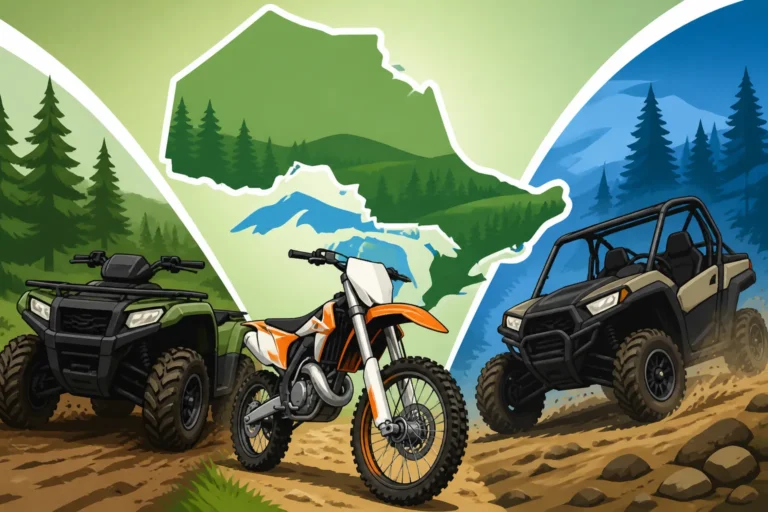
To help visualize how the width limit applies, here's a general overview of common ORV types and how they typically fare against the 2.03-metre rule for road use in Ontario.
| ORV Class / Type | Typical Width Range (approx.) | Road Legal (Width Aspect) | Notes |
|---|---|---|---|
| Traditional ATV | 1.0 – 1.2 metres | Generally Yes | Most ATVs are well within the 2.03m limit. |
| Two-Up ATV | 1.1 – 1.3 metres | Generally Yes | Similar to traditional ATVs, typically compliant. |
| Utility Side-by-Side | 1.5 – 1.8 metres | Often Yes | Many utility models are designed to be under the 2.03m limit. Crucial to check specific models. |
| Sport Side-by-Side | 1.6 – 2.2 metres | Varies / Often No | Many sport models (e.g., 72" or wider) exceed 2.03m from the factory. Critical to measure. |
| Multi-Purpose Off-Highway Vehicle (MPV) | Varies widely | Depends on specific model | These are often larger, specialized vehicles. Must comply with all ORV regulations, including width. |
| Off-Road Motorcycle (Dirt Bike) | ~0.8 metres | N/A (Different rules) | Dirt bikes are not considered ATVs or ROVs for road use; they follow motorcycle regulations if permitted. |
Note: All widths are approximate and can vary significantly by manufacturer, model, and year. Always measure your specific machine.
Disclaimer: This article is for general informational purposes only and does not constitute professional advice. Laws, prices and regulations vary by location and change over time. Consult a qualified professional for guidance on your specific situation.