Where an Off-Road Motorcycle Fits in Ontario
Navigating the world of off-road vehicles in Ontario can feel like trying to solve a complicated puzzle, especially when you're passionate about dirt bikes. Many riders dream of taking their off-road motorcycles from the dusty trails directly onto paved roads for quick hops between riding areas or simply to run an errand, only to be met with a wall of confusion and conflicting information. This guide is here to untangle the complexities and clarify exactly where an off-road motorcycle fits into Ontario's legal framework, particularly concerning road use.
Understanding Ontario's ORV Classes: Where Does an Off-Road Motorcycle Land?
When we talk about off-road vehicles (ORVs) in Ontario, it's easy to lump everything together. However, the province's regulatory system, primarily governed by the Off-Road Vehicles Act, is quite specific, delineating different classes of machines based on their design and intended use. Understanding these distinctions is absolutely crucial, as they dictate everything from where you can ride to the type of licensing and equipment you need. Unfortunately, this is where off-road motorcycles often fall into a grey area that many find frustratingly restrictive.
The Legal Definition of an Off-Road Motorcycle
In Ontario, an "off-road motorcycle" refers to a two-wheeled motor vehicle that is specifically designed for off-road use. Think about the classic dirt bike—knobby tires, long-travel suspension, lightweight frame, and usually no turn signals, mirrors, or extensive lighting found on street motorcycles. The key here is "designed for off-road use." This design intention is what largely separates it from a street-legal motorcycle, which is built to meet entirely different safety and equipment standards for public road operation. This distinction is not just a technicality; it’s the bedrock of why dirt bikes face such limitations on public highways and roads. It means that while they are powerful and agile machines, their fundamental construction is optimized for tearing up trails, not cruising down Main Street.
The province isn't trying to be difficult; rather, these definitions exist for safety and to maintain the integrity of road systems. An off-road motorcycle's tires, for instance, are designed for maximum grip on loose terrain like mud, gravel, and dirt, not for the asphalt grip and longevity required for road riding. Furthermore, their suspension systems are built to absorb massive impacts from jumps and rough terrain, which is very different from the smooth, controlled ride expected on a paved surface. These design differences, while making them phenomenal off-road, are precisely what make them unsuitable for the road in the eyes of the law, meaning they don't quite fit into the neatly defined categories that allow for routine road use.
Comparing Off-Road Motorcycles to ATVs and ROVs
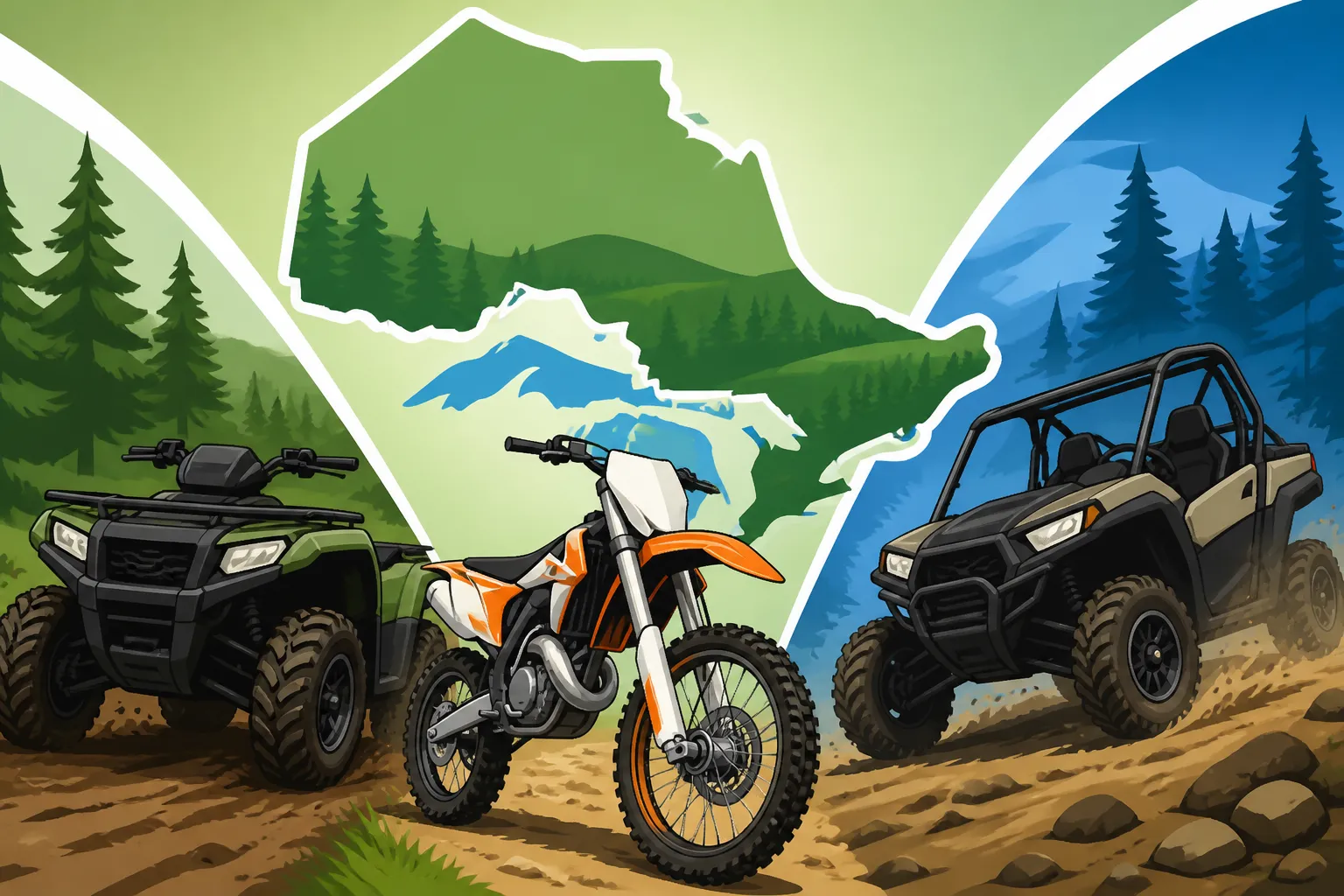
To truly grasp the challenges faced by off-road motorcycle enthusiasts, it helps to compare them to other common ORV types in Ontario: All-Terrain Vehicles (ATVs) and Recreational Off-highway Vehicles (ROVs), which often include side-by-sides (UTVs). ATVs are typically single-rider (or two-up) machines with handlebars, four wheels, and a straddle seating position. ROVs, on the other hand, are often multi-passenger machines with a steering wheel, side-by-side seating, and frequently a roll-over protective structure (ROPS) and seatbelts, much like a small car. Both ATVs and ROVs, under specific conditions and by-laws, have seen increasing road access in Ontario over the years.
The key difference lies in the specific regulatory classes they fall under. The Off-Road Vehicles Act includes provisions for ATVs and ROVs to operate on certain roads, subject to municipal by-laws, speed limits, and equipment requirements. These machines, particularly ROVs, often have features that somewhat bridge the gap between pure off-road and on-road vehicles, or can be more easily modified to meet requirements such as width limits and lighting. Off-road motorcycles, however, often don't fit cleanly into these road-friendly ORV classes, or they lack the inherent characteristics that make ATVs and ROVs more readily adaptable for limited road use. It's a fundamental classification issue that leaves dirt bike riders feeling a bit left out when they see quads and side-by-sides traversing local roads.
This table helps illustrate some of the fundamental differences in how Ontario views these various off-road machines, especially concerning road access:
| Feature | Off-Road Motorcycle (Dirt Bike) | All-Terrain Vehicle (ATV) | Recreational Off-highway Vehicle (ROV/UTV) |
|---|---|---|---|
| Wheels | 2 | 4 | 4+ |
| Steering | Handlebars | Handlebars | Steering Wheel |
| Seating Position | Straddle | Straddle | Side-by-Side (Bucket Seats) |
| Typical Road Access | Very Limited (Generally Prohibited) | Limited (By-law & Condition Based) | Limited (By-law & Condition Based) |
| Safety Features | Helmet (Primary), Riding Gear | Helmet (Primary), Riding Gear | Helmet, Seatbelts, ROPS (Primary) |
| Engine Cap (ORV) | N/A (Focus on design) | < 1,000cc (for most road use) | < 1,700kg, < 2.03m wide (for most road use) |
| Primary Use | Dedicated Off-Road Trail/Track | Off-Road Trail, Utility, Farm | Off-Road Trail, Utility, Farm, Recreation |
The Harsh Reality: Road Access Limitations for Off-Road Motorcycles
While the allure of linking trails or simply riding to a local store on your dirt bike is strong, the reality in Ontario is that public road access for off-road motorcycles is severely restricted. This isn't just an inconvenience; it's a legal barrier that riders need to understand to avoid hefty fines and potential impoundment of their machine. It’s a common source of frustration for riders who see other ORVs on the road and wonder why their dirt bike is treated differently, but the reasons are deeply embedded in safety and regulatory frameworks.
Why Dirt Bikes Aren't Generally "Street Legal" in Ontario
The primary reason off-road motorcycles aren't generally street legal in Ontario boils down to their design and the stringent requirements for vehicles operating on public roads. Unlike motorcycles manufactured to meet Canadian Motor Vehicle Safety Standards (CMVSS) for street use, dirt bikes typically lack essential components such as:
- Proper headlamps (often not DOT-approved, or insufficient for night road use)
- Tail lights and brake lights that meet road standards
- Turn signals
- Side mirrors
- A horn
- DOT-approved tires suitable for pavement
- A licence plate bracket and illumination
- Odometers or speedometers that are required for road vehicles.
Attempting to add these components yourself is often not enough, as the base vehicle itself may not be certified for road use. Even if you meticulously install every missing piece, the fundamental classification of the vehicle as an "off-road motorcycle" in its Vehicle Identification Number (VIN) and registration can prevent it from ever being legitimately licensed for general road use. This means that converting a dirt bike to a "dualsport" legally registered for the street, as might be possible in some other jurisdictions, is extremely difficult, if not impossible, within Ontario's current regulatory framework. Many riders just accept that their dirt bike is for the trails, and for everything else, they'll need a different type of machine or a truck and trailer.
Designated Road Allowances and Exceptions
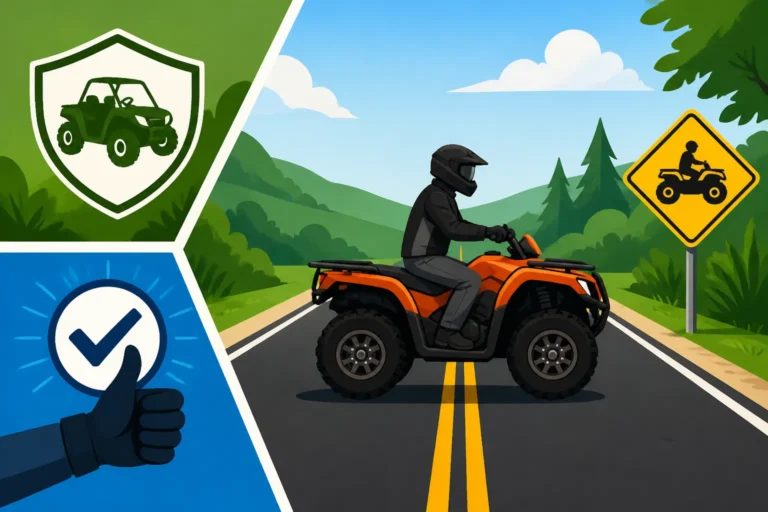
Despite the general prohibition, there are very limited scenarios where an off-road motorcycle might legally touch a paved or gravel road in Ontario. These are typically not for general travel but for very specific, short-distance movements. One key exception is crossing a public highway or road where authorized. This isn't about riding along the road but about traversing it at a right angle to get from one section of trail or private property to another. Even in these crossing scenarios, strict rules apply: you must come to a complete stop, yield to all traffic, cross at a 90-degree angle, and if you're under 16, you usually can't operate the machine on any part of a public road, even for crossing. This is where nuances like [Ontario's Off-Road Minimum Age of Twelve] come into play, but even for older riders, permission to cross is not permission to ride.
Some remote areas or specific municipalities, through local by-laws, might have designated very limited sections of road allowances that permit ORV use to connect trails. However, these are exceptionally rare for off-road motorcycles specifically, compared to ATVs and side-by-sides. Even where such by-laws exist, they come with stringent conditions: usually a very low speed limit (e.g., [Ontario's 20 and 50 km/h Speed Limits]), strict helmet requirements ([Ontario ATV Helmet Law]), and often only during specific hours or seasons. It's a complex patchwork, and the onus is entirely on the rider to know the local rules precisely. You can't just assume; you need to check the specific by-law for that particular stretch of road.
Essential Equipment and Modifications (If Road Use Were Permitted)
Even though off-road motorcycles face significant hurdles to legal road use in Ontario, it's helpful to consider what kinds of equipment and modifications would be necessary if the laws were to change or if you were simply aiming to enhance your machine for off-road safety. Many of these items are standard on street-legal motorcycles for a reason: they are crucial for visibility, control, and compliance in traffic. This hypothetical exercise helps underscore just how fundamentally different off-road machines are from their street-legal counterparts.
Lights, Signals, and Mirrors: What Would Be Needed
For any vehicle to be considered roadworthy in Ontario, it must have a full complement of functional lighting and signaling equipment. For an off-road motorcycle, this would mean installing a proper headlight (low and high beam) that illuminates the road effectively and is street-legal, as well as a robust taillight that is visible from a distance and incorporates a functional brake light. Turn signals, both front and rear, would be non-negotiable for indicating intentions to other road users. These signals would need to be visible from specific angles and distances, which often means they need to be larger and brighter than anything typically found on a trail-oriented dirt bike.
Beyond lighting, mirrors are essential for safely monitoring traffic behind and to the sides. A street-legal vehicle typically requires at least one rearview mirror, and often two, mounted securely to provide an unobstructed view. Most dirt bikes come with no mirrors at all, or only very small, foldable ones that are inadequate for road use. Furthermore, an audible warning device—a horn—would be mandatory for alerting pedestrians or other vehicles. Many off-road motorcycles have a small, often weak horn, or none at all, designed more for trail etiquette than emergency road use. Equipping a dirt bike with all of these components, and ensuring they are durable enough for off-road abuse while meeting street-legal standards, is a significant undertaking, both technically and financially. This is where riders might consider a universal accessory kit, though specific approvals would still be an issue.
Mufflers, Tires, and Safety Gear Considerations
Another critical area for road legality involves emissions and noise. Street-legal motorcycles must adhere to strict muffler and exhaust noise regulations. Many aftermarket dirt bike exhausts are designed for performance and weight reduction, often resulting in noise levels that would be illegal on public roads. Therefore, a compliant exhaust system would be necessary, which might compromise some of the performance gains enthusiasts seek. Similarly, tires are a major concern. The knobby tires that give off-road motorcycles incredible grip in mud and dirt wear out extremely quickly on pavement and offer poor traction on wet or smooth surfaces. SuperATV, for instance, offers a range of tires for various ORV types, but finding a dual-sport tire that truly performs well both on severe trails and on pavement in all conditions is a balancing act, and even then, legal certification for road use on an off-road motorcycle chassis remains the fundamental barrier.
Beyond the machine itself, rider safety gear is paramount. While helmets are already mandatory for all ORV use in Ontario ([Ontario ATV Helmet Law]), a road-legal context would likely emphasize DOT-approved full-face helmets, as well as robust riding jackets, pants, gloves, and boots that offer impact and abrasion protection at higher speeds. While many dirt bike riders already wear excellent protective gear, the specific requirements for road safety can sometimes differ. It’s about ensuring protection not just from falls on dirt, but from collisions with other vehicles on hard surfaces. So, while many riders might have suitable gear for the trail, ensuring it meets street-specific safety standards would be another layer of consideration.
Licensing, Registration, and Insurance for Off-Road Motorcycles
Even if by some legislative miracle off-road motorcycles gained broader road access, the existing requirements for licensing, registration, and insurance in Ontario would still apply, and they are not trivial. These are the fundamental administrative pillars that ensure accountability, identify vehicles, and provide financial protection in case of an accident. Misunderstanding these requirements can lead to serious legal consequences, regardless of whether you're on a trail or hypothetically on a road.
Provincial Registration and Plates
In Ontario, all off-road vehicles, including off-road motorcycles, must be registered with the Ministry of Transportation (MTO) and have a valid [Ontario ORV Plates and Where They Mount]. This means obtaining an [The Ontario Vehicle Permit Explained] (the green ownership document) and displaying a licence plate on your machine. This registration process typically involves proving ownership (often with a bill of sale), paying applicable taxes like the [13 Percent RST on an Ontario ATV], and presenting valid identification at a ServiceOntario centre. The province issues a distinct ORV plate, which is different from a regular motorcycle plate, and it must be clearly visible. For an off-road motorcycle, finding a secure and visible spot for this plate that won't get ripped off or damaged during aggressive trail riding can itself be a minor challenge.
It's important to remember that this registration only permits the machine to be used off-road, or in those extremely limited circumstances where road crossing or specific by-law-designated road allowances are permitted for ORVs. It does not magically confer "street legal" status. The plate identifies the machine, but it doesn't grant unrestricted access to public highways. Riders often forget that simply having a plate does not mean you can take your dirt bike on the road, and this misunderstanding is a common reason for fines. [No Annual Renewal for an Ontario ORV] is a nice perk, but it doesn't change the underlying rules of where you can ride.
The Driver's License Conundrum
For road use in Ontario, operating any motor vehicle, including an ORV on a permitted road segment, requires a valid driver's license. If an off-road motorcycle were somehow deemed suitable for road travel, you would likely need a full M-class motorcycle license ([Ontario's G2 and M2 Licence Requirement]) to operate it on a public highway. A standard G-class car license would generally not suffice for a two-wheeled vehicle. This means that even if all the equipment were in place, a dirt bike rider without an M-class license would still be breaking the law by riding on the street. This is a significant hurdle, as many dirt bike enthusiasts might only possess a G-class license, sufficient for trailering their machine but not for riding it on the road.
Furthermore, the age requirements are a factor. While a 12-year-old can ride an ORV off-road under supervision, operating a motor vehicle on a public road in Ontario requires a minimum age that aligns with the graduated licensing program, typically 16 for a G1 or M1. So, the moment an ORV enters a public road, even if permitted, the operator's licensing must comply with standard road rules, not just the [Ontario ATV Minimum Age Off-Road]. This layering of requirements can be confusing, but the bottom line is that road rules generally supersede ORV-specific rules when you're on a paved surface.
Insurance Requirements for Off-Road Use
Before you even think about riding an off-road motorcycle, whether on a trail or in the rare instance of road crossing, it must be insured. Ontario mandates that all ORVs have a valid motor vehicle liability insurance policy. This is not optional. Without it, you are not only subject to significant fines (potentially thousands of dollars) but also risk having your vehicle impounded. [Ontario ATV Insurance Requirements] are clear: proof of insurance must be carried with you whenever you operate your machine. This insurance protects you financially in the event of an accident, covering property damage and bodily injury to third parties.
It's crucial to understand that an off-road insurance policy is specifically tailored for off-road risks. It typically covers you when you're on trails, private property (with permission), or during those sanctioned road crossings. However, an off-road policy is not a street-legal policy. It would generally not provide coverage if you were found riding your non-street-legal off-road motorcycle on a public highway in defiance of the law. Insurers write policies based on the declared use and legal status of the vehicle, and riding outside of those parameters could void your coverage entirely in the event of a claim. So, while insurance is mandatory, it won't be a get-out-of-jail-free card for illegal road use.
Where You Can Legally Ride Your Off-Road Motorcycle in Ontario
Given the stringent restrictions on public road use, off-road motorcycle enthusiasts in Ontario often feel limited in where they can legally and safely enjoy their sport. However, there are significant opportunities to ride, provided you understand and respect the various permissions and designations for off-road activities. It’s about knowing the rules of the land, whether it’s private, club-managed, or public.
Private Property and Landowner Permissions
The simplest and often most accessible place to ride an off-road motorcycle in Ontario is on private property, provided you have explicit permission from the landowner. This could be your own land, a friend's farm, or a gravel pit where the owner has granted you access. When riding on private land, many of the provincial regulations regarding speed, helmet use (though still highly recommended for safety!), and even some equipment requirements are less strictly enforced by law enforcement, as long as you're not causing a public nuisance or damage. However, you still absolutely must have proper [Ontario ATV Insurance Requirements] to cover any potential liability if something goes wrong.
The critical phrase here is "explicit permission." Trespassing is a serious offence, and riding without permission can lead to legal action, fines, and strained relationships with landowners. Always ask, and if possible, get that permission in writing. Respecting private property also means staying on designated areas, closing gates, and leaving no trace behind. Many rural landowners are supportive of responsible ORV use, and building those relationships can open up fantastic riding opportunities without the regulatory headaches associated with public lands or roads. Remember that while off-road on private land, you're not free from all rules, especially if there's damage or injury, but it's certainly the least restrictive environment.
Sanctioned Trails and Off-Road Parks
Ontario boasts a fantastic network of organized trails and dedicated off-road parks, offering some of the best riding experiences for dirt bike enthusiasts. Organizations like the Ontario Federation of ATV Clubs (OFATV) manage extensive trail systems that often welcome dirt bikes alongside ATVs and side-by-sides. These trails are typically well-maintained, signed, and offer a variety of terrain challenges. To access these trails, you generally need to purchase an annual [Ontario ATV Trail Permit Cost] from the OFATV or a specific club, which helps fund trail development, maintenance, and insurance. Many riders find that a permit pays for itself quickly, given the sheer volume of trails available.
Examples of popular riding areas include parts of the [Ontario's OFATV Trail Network], the [The Ganaraska Forest for Ontario Riders] (with specific zones for motorized use and requiring its own pass), and the Haliburton ATV Association (HATVA) network, which offers [Haliburton's 1,000 Kilometres] of trails. These areas are designed for off-road enjoyment, meaning your dirt bike is perfectly at home there. They often have designated staging areas, parking for trailers, and sometimes even amenities like washrooms. It's crucial to check the specific rules of each club or park, as some may have restrictions on machine type, noise levels, or riding hours. Riding here provides a structured, safe, and legal environment explicitly designed for off-road motorcycles, making it a primary destination for many.
Navigating Crown Land Rules
For those seeking a more adventurous and expansive riding experience, Ontario's vast tracts of Crown Land offer significant opportunities. Crown Land is publicly owned land, and much of it falls under Ontario's "free use" policy for recreational activities. This means you can generally ride your off-road motorcycle on Crown Land without a specific permit, as long as you adhere to the [Riding Crown Land in Ontario] regulations. However, "free use" does not mean "anything goes." There are critical distinctions and restrictions you must be aware of to avoid breaking the law.
Key rules for riding on Crown Land include:
- Designated Trails: You should generally stick to existing trails or roads. Creating new trails is usually prohibited.
- Environmental Protection: You must not damage natural features, wetlands, or waterways. Crossing creeks must be done responsibly.
- Respecting Closures: Certain areas of Crown Land may be closed seasonally or permanently for environmental protection, logging operations, or other reasons. Always check for signage or local notices.
- Permitted Activities: Riding is usually permitted, but activities like camping or hunting with an ORV have their own specific rules.
- Private Inholdings: Be vigilant for private property within or adjacent to Crown Land; accidentally trespassing is still an offense.
Navigating Crown Land requires good map-reading skills (like those offered by the QuadON app), a GPS, and an understanding of the Public Lands Act. While it offers unparalleled freedom and beauty, it also demands a higher degree of self-reliance and environmental responsibility. It’s an amazing resource for dirt bike riders, but one that requires careful planning and adherence to responsible riding practices to ensure its continued accessibility.
Navigating the Nuances: Municipal By-laws and Regional Differences
Ontario's approach to ORV regulation is complex, with a blend of provincial legislation and local municipal by-laws. This decentralized system means that what might be permissible in one township could be strictly prohibited in the next. This patchwork of rules creates a constant challenge for off-road motorcycle riders, who must be diligent in understanding the hyper-local regulations wherever they choose to ride, especially when any form of road interaction is involved.
How Local Rules Can Impact Riding Opportunities
The provincial [The Off-Road Vehicles Act and Ontario Riders] sets the overarching framework for ORV use, but it grants municipalities the power to enact their own by-laws regarding where and how ORVs can operate on local roads under their jurisdiction. While many municipalities have opened certain roads to ATVs and side-by-sides, specific provisions for off-road motorcycles are much rarer. Most by-laws are drafted with four-wheeled ORVs in mind, often stipulating weight, width, and engine size limits that don't directly apply to dirt bikes, or simply omitting them from permitted classes. Even if a road is "open to ORVs," it's critical to check if "off-road motorcycles" are explicitly included.
This means a dirt bike rider planning a trip must do their homework for every single municipality they intend to traverse or ride near. Checking a township's website for their specific ORV by-law is essential. Some municipalities might allow ORVs to use shoulders or ditches for short distances, while others may completely prohibit ORVs on all municipal roads. The frustration for dirt bike riders is that while [Ontario Municipalities That Opened Their Roads] might be increasing for quads and side-by-sides, off-road motorcycles often remain outside these expanded access zones, leaving them with limited options beyond dedicated trails or private land.
Advocating for Greater Access: What Riders Can Do
While the current situation for off-road motorcycles on Ontario roads is restrictive, it doesn't mean it's set in stone forever. Changes in legislation and municipal by-laws often come about through sustained advocacy from the riding community. If you're passionate about seeing greater, responsible access for off-road motorcycles, there are several avenues for action. Joining local ORV clubs or provincial federations is a great first step. These organizations often have a stronger collective voice and actively lobby local councils and provincial government bodies. They conduct studies, present proposals, and build relationships with policymakers.
Individual riders can also make a difference by engaging directly with their local municipal councils. Attending council meetings, writing letters, or sending emails to express your desire for expanded, responsible ORV access (specifically for dirt bikes) can highlight the issue. When doing so, emphasize safety, responsible riding practices, and the economic benefits that ORV tourism can bring to rural communities. Proposing specific, well-thought-out solutions—such as designated connector routes or clearly defined speed limits—can be more effective than general complaints. By demonstrating a commitment to safety and community, off-road motorcycle riders can slowly but surely work towards a future with more inclusive road access.
Disclaimer
This article is for general informational purposes only and does not constitute professional advice. Laws, prices and regulations vary by location and change over time. Consult a qualified professional for guidance on your specific situation.