Ontario Riders Crossing Into Michigan
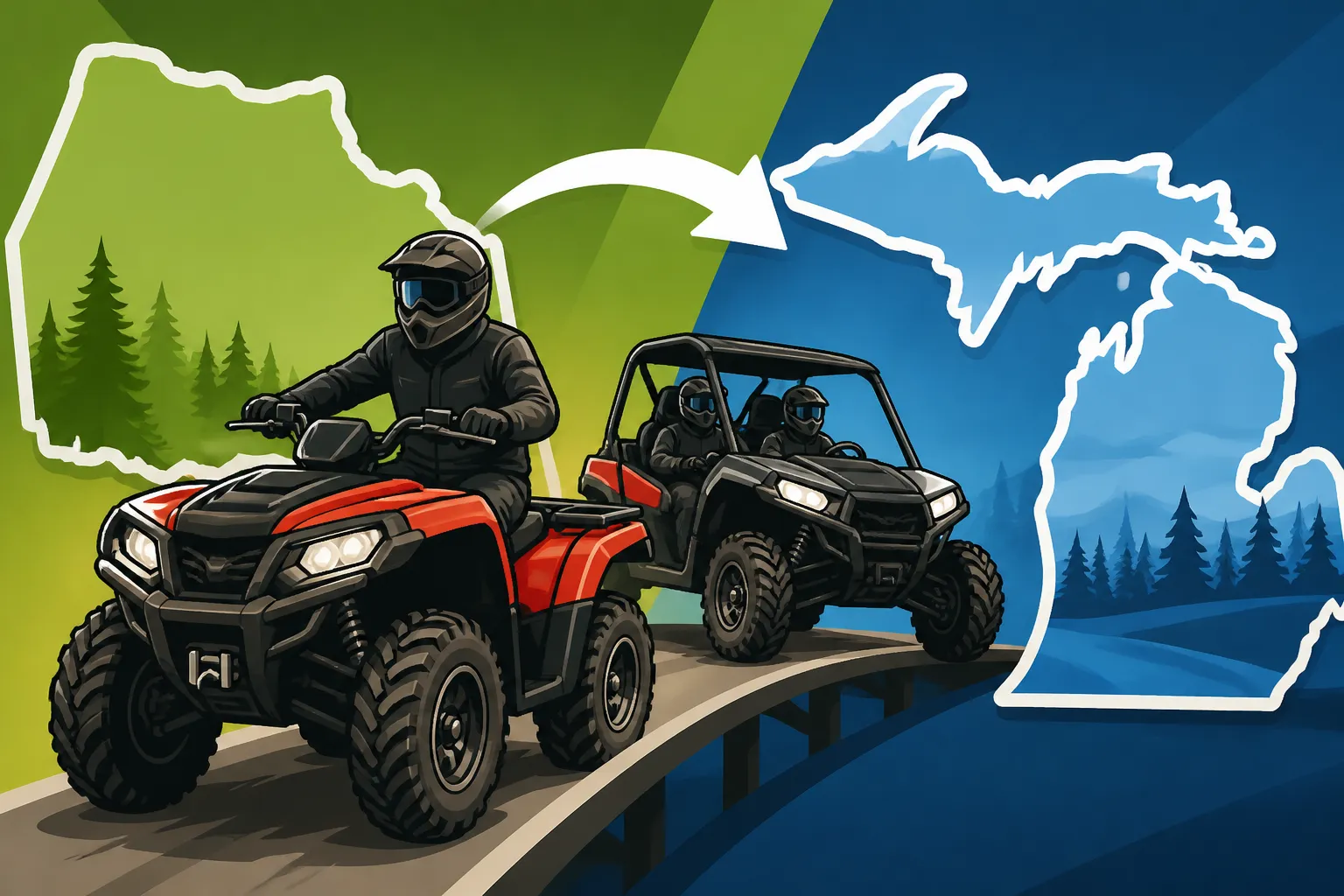
Taking an ATV or UTV from Ontario into Michigan involves more than crossing the border with your machine. Your Ontario registration, trail permit, insurance and riding permissions each have separate limits, and they do not automatically satisfy Michigan requirements. Plan the border crossing, confirm the rules for the exact place you intend to ride, and check with your insurer before loading up.
What to sort out before you cross the border
Start by deciding whether you are transporting your own machine for temporary personal use or taking it to Michigan for sale, repair, or permanent import. The paperwork and border questions can differ. For a recreational trip, keep proof that you own the ATV or UTV and that it is registered in Ontario, if registration is required for it. Carry your Ontario vehicle permit and any bill of sale or other ownership document that supports it.
An Ontario registration is not the same as permission to ride on Michigan trails. It identifies the vehicle and its registered owner under Ontario’s system; it does not replace any Michigan trail or public-land authorization. Similarly, an Ontario trail permit is not a general North American pass. Check Ontario ATV Trail Permits Explained before you travel, then verify requirements with the Michigan land manager or trail operator for the riding area you plan to use.
Before leaving, make a short checklist:
- Confirm ownership and registration documents. Bring the original documents you normally carry, or confirm with the relevant authority what copies are acceptable. If the paperwork is incomplete, resolve that before the trip rather than expecting a border officer or trail staff member to sort it out.
- Call your insurer. Ask whether your ATV or UTV liability coverage applies in the United States, whether coverage is limited by location or type of use, and what proof you should carry. An Ontario policy is not automatically proof that you have the coverage Michigan requires. Ontario riders can review the basics in Ontario ATV Insurance Requirement.
- Identify the exact riding destination. Rules can differ between state-designated ORV trails, public land, private parks, and private property. Check the requirements for the site itself, not just general advice about riding in Michigan.
- Check the machine and transport setup. Make sure the ATV or UTV is secure on its trailer, that the trailer and tow vehicle meet the rules for the route, and that the machine is in the condition required by the destination.
- Prepare for both border crossings. Keep ownership records and travel details accessible, and be ready to answer questions about the machine, how long it will be in the United States, and whether you are bringing anything else that must be declared.
The practical distinction is that border clearance, vehicle registration, insurance and riding access are separate issues. A machine can cross the border without that automatically giving it permission to use a particular trail.
| Item | What it establishes | What it does not establish |
|---|---|---|
| Ontario vehicle permit and ownership documents | The vehicle’s Ontario registration and ownership information | Permission to ride on Michigan trails or public land |
| Ontario trail permit | Access covered by the Ontario permit’s terms | A Michigan ORV license, trail pass, or permission from a Michigan landowner |
| Insurance documents | The coverage your policy actually provides | That the policy meets every Michigan requirement or covers every kind of riding |
| Border paperwork | Information needed for temporary travel or importation questions | Registration or trail access in either jurisdiction |
If the ATV is not registered in your name, or you have bought it shortly before the trip, gather the supporting paperwork before departure. The process for an Ontario machine with out-of-province history is covered in Ontario Rules for an Out-of-Province Machine. For a machine purchased in the United States and brought back into Ontario, see Importing a Quad From the United States; that is a different situation from taking an Ontario-registered machine south for a visit.
Ontario permits do not automatically cover Michigan riding
The short answer is: do not assume your Ontario permit gives you access in Michigan. Ontario trail permits are tied to the systems and lands covered by their terms. Michigan manages its own ORV access, and a specific trail, public-land area, or private riding park may have its own permit, registration, or day-use requirements.
Michigan has state ORV requirements for riding in certain places, and the details can depend on the land and the type of route. Some areas may require a Michigan ORV license or other authorization; private facilities may set their own entry conditions. The relevant authority could be a state agency, local land manager, or private operator. Confirm the current requirements directly before you ride, including whether a nonresident vehicle can obtain the required authorization and how it must be displayed.
Do not rely on one general statement such as “Michigan requires a permit” or “the Ontario permit is accepted.” Those statements can miss important distinctions:
- Where you ride: State-managed trails and private ORV parks may not use the same access system.
- What you ride: Definitions and equipment rules may distinguish an ATV from a side-by-side or other ORV.
- Who operates it: Age, supervision, and safety-certificate requirements may apply differently depending on the rider.
- How the vehicle is used: Riding off-road is not the same as operating on a public road, even if a road connects two trail sections.
- How you pay or register: A site may require a vehicle authorization, a rider pass, an entry fee, or more than one of these.
Before leaving home, contact the trail operator or public-land manager and ask direct questions. Give them the make and type of machine, the fact that it is registered in Ontario, and the area you want to ride. Ask whether an Ontario plate or registration is accepted as proof of vehicle status, whether a separate Michigan authorization is needed, and whether there are special rules for nonresident riders. If a pass is required, ask how and where to buy it and whether it must be attached to the machine.
A useful way to keep the systems straight is to treat Ontario and Michigan access as separate unless the relevant Michigan authority explicitly says otherwise. Which Provinces Take an Ontario Permit concerns permit recognition in other Canadian jurisdictions; it does not establish reciprocity with a U.S. state. Likewise, Ontario’s Free Use Policy for Riders describes a limited Ontario land-use framework, not a general right to ride on Michigan public land.
That separation also matters if you plan to ride in Ontario before or after the Michigan trip. A Michigan permit does not replace Ontario registration or an Ontario trail permit where those are required. Keep the correct authorization for each place, and avoid assuming that one sticker, plate, or receipt covers the whole journey.
Insurance, roads, and equipment need their own checks
An Ontario ATV or UTV insurance policy may have territorial limits or conditions. Before travel, ask your insurer or broker whether liability coverage applies while the machine is in Michigan, including on the specific type of riding area you plan to use. Ask whether coverage changes if you ride on a road, take part in an organized event, carry a passenger, or use a rental or borrowed machine. Keep the insurer’s contact information and the proof of coverage they tell you to carry.
Do not treat the existence of a policy as a substitute for checking its terms. A policy that covers liability in one setting may not cover every use or location, and a trail operator may ask for proof of coverage or impose its own conditions. If your insurer cannot confirm that the planned riding is covered, do not assume that the Ontario rules settle the question. The same careful approach applies at home; Insurance and Ontario ORV Registration explains why registration and insurance are related but separate matters.
Road use is another potential trap. An ATV that is registered in Ontario is not automatically allowed on Michigan public roads. Road access can depend on state law, local rules, road designation, machine equipment, and the rider’s qualifications. A trail crossing over a road is not permission to travel along that road. Follow the marked route and verify any road segment with the responsible local authority before using it.
A side-by-side also deserves a specific check. Its classification and permitted use may differ from those of a conventional quad, and a trail system can set width, passenger, or equipment restrictions. Do not assume that a wide UTV will fit every trail or that a route suitable for a smaller ATV is suitable for your machine. Check the operator’s vehicle limits and any restrictions on doors, restraints, helmets, lights, or noise equipment.
Use a basic pre-ride checklist:
- Confirm that your machine is allowed on the selected trail or property.
- Check whether the site requires a Michigan ORV authorization, a separate entry pass, or both.
- Verify that your Ontario insurance covers the trip and planned use.
- Confirm whether road sections are permitted for your machine and rider.
- Check age, supervision, passenger, helmet, and equipment rules for the destination.
- Carry the permit, registration, insurance, and ownership documents required for the trip.
- Make sure any required decals or documents are displayed or carried as directed.
For a broader Ontario overview of road access and the limits of road use, see Riding an ATV on Ontario Roads. It cannot answer Michigan’s local rules, but it helps keep the underlying distinction clear: off-road registration does not by itself make an ATV road-legal.
Plan the return trip and avoid common assumptions
When coming back to Ontario, be prepared to answer questions about what you are bringing into Canada. If you bought equipment, parts, or another vehicle in the United States, keep receipts and declare items as required. If the ATV was taken south temporarily, retain the documents that show it was already owned and registered in Ontario before the trip. This can help explain that it is returning with you rather than being a new purchase.
If the machine was repaired, modified, or replaced while in the United States, keep the invoices and related paperwork. Work done on a vehicle and parts acquired during travel may affect what you need to declare. For questions about a permanent move, sale, or import rather than a short recreational visit, contact the appropriate border authority before travelling; temporary recreational transport and importing a vehicle are not the same process.
Common mistakes are usually caused by treating one document as if it answers every question:
- “My Ontario plate means I can ride.” The plate helps identify the vehicle under Ontario’s system. It does not grant Michigan trail access.
- “My Ontario permit is valid across the border.” Do not assume that. Confirm Michigan requirements for the exact trail or property.
- “The trail is open, so any machine can use it.” Operators may restrict vehicle types, width, equipment, or rider age.
- “My Ontario insurance automatically covers everything.” Ask the insurer about the territory and the specific kind of riding.
- “A road link between trails is part of the trail.” Confirm whether the road is legally open to your machine.
- “The border only cares about the trailer.” Be ready to discuss the ATV or UTV, ownership, purpose of travel, and anything else you are carrying.
A little confirmation before the trip is usually easier than arriving at a trailhead and discovering that the machine lacks a required authorization or does not meet the route’s limits. Save contact details for the trail operator and insurer, and keep the relevant documents together in a waterproof pouch or another secure place. If you intend to ride more than one area, repeat the check for each one rather than assuming the first permit covers the next destination.
The simplest rule is to treat the Ontario and Michigan systems independently: carry valid Ontario documents for the machine and its return, then meet the requirements set by the Michigan riding area. That approach avoids confusing registration with access, or a trail pass with insurance.
Disclaimer
This article is for general informational purposes only and does not constitute professional advice. Laws, prices and regulations vary by location and change over time. Consult a qualified professional for guidance on your specific situation.