Manufacturers Behind the Training
Ontario’s Ready To RideON training is linked to the off-highway vehicle industry, including manufacturers and distributors. That raises a fair question: who shaped the lessons, and how should riders use them? The key is to treat the course as a practical safety starting point—not a substitute for Ontario’s rules, adult supervision where required or hands-on practice.
Who is behind the training
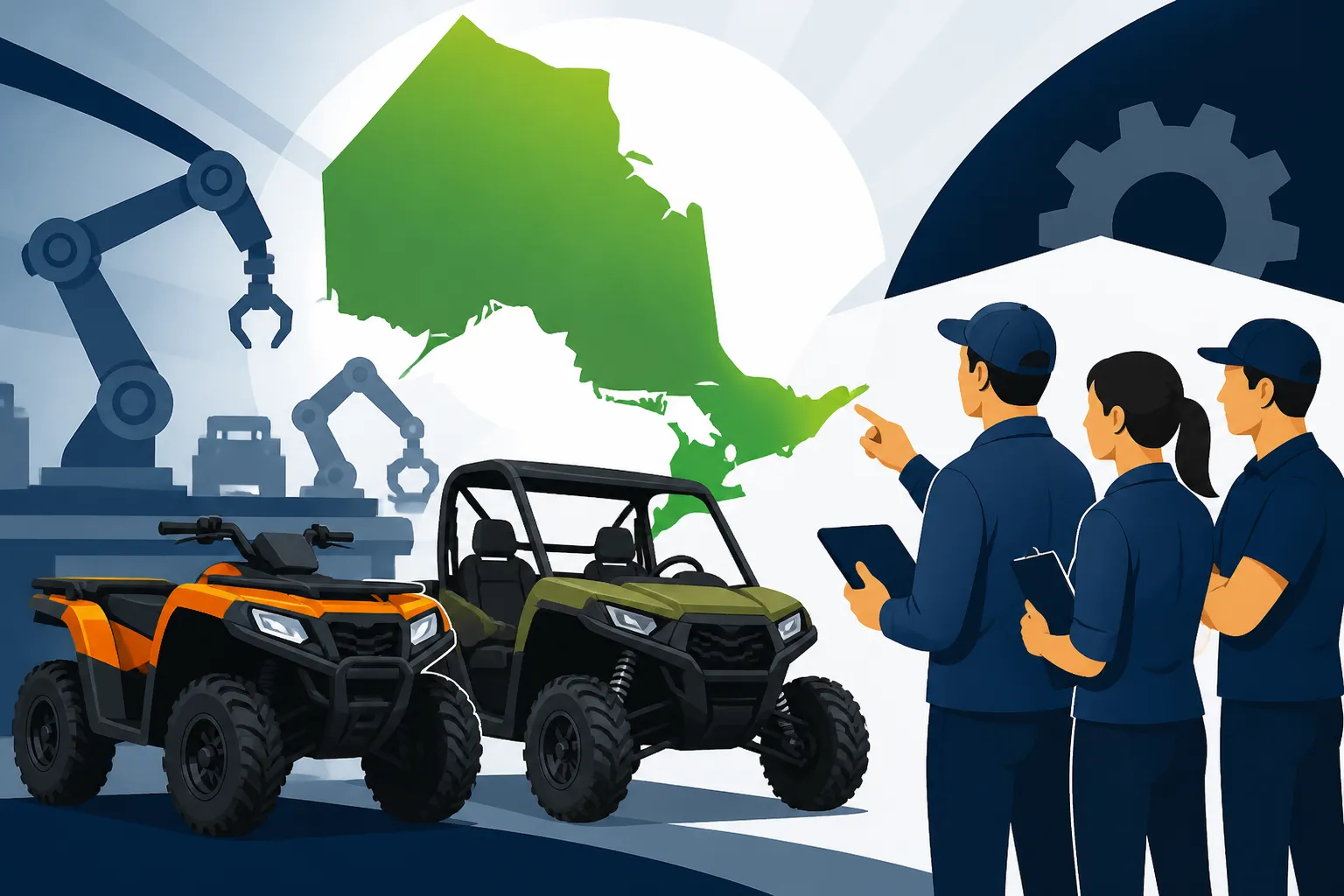
Ready To RideON is an online ATV safety program associated with the Canadian off-highway vehicle industry. The Canadian Off-Highway Vehicle Distributors Council, commonly known as COHV, represents companies involved in distributing off-highway vehicles in Canada, including manufacturers. The program is an industry-supported education effort, not a ServiceOntario registration course or a government-issued rider licence.
That distinction helps explain the manufacturers’ role. Companies that build and distribute ATVs have a direct interest in riders understanding how to operate them safely. They can contribute knowledge about common controls, vehicle handling and safety practices across the category. A shared course can introduce those basics to new riders before they operate a machine.
It also means riders should understand what the program is—and what it is not. It is general safety education for off-highway vehicle use. It is not a certification that every rider has demonstrated practical skill on a particular model, and it does not authorize a person to ride where or how Ontario law prohibits.
The connection to manufacturers can be useful because the course is designed around the kinds of risks riders encounter, rather than around the paperwork involved in owning a quad. But industry support does not make the course a complete operating manual for every vehicle. A rider still needs to read the owner’s manual for the exact machine, learn its controls and follow the manufacturer’s instructions.
Why manufacturers support rider education
An ATV is not simply a small car or motorcycle. It has its own handling characteristics, and riders need to understand how body position, speed, terrain and load can affect stability. A general course can explain those concepts in a consistent way to a beginner, even before they choose a particular make or model.
Manufacturers and distributors also have a practical reason to promote safety education: safer riding helps reduce preventable injuries and damage. That does not mean an online program can prevent every collision or rollover. It means the industry can help provide information about safer decisions, while riders and parents remain responsible for applying it.
The course should therefore be viewed as one part of a broader preparation process. It can help a new rider recognize hazards and learn safety principles. It cannot assess how that person reacts to a sudden obstacle, manages a hill or controls a machine in changing trail conditions. Those skills require supervised practice on an appropriate machine.
What the industry connection does not mean
Industry backing does not make Ready To RideON a legal requirement for every Ontario rider. Ontario does not generally require a rider to hold a Ready To RideON certificate before using an ATV. The course is voluntary, and completion does not replace legal obligations that may apply to the rider, vehicle or location.
It also does not mean that every manufacturer’s operating advice is identical. Machines differ in size, weight, power, seating, controls and intended use. A lesson about general riding principles should not be treated as permission to carry a passenger on a single-rider machine or operate a vehicle beyond its designed capacity.
For a closer look at the course’s format and subjects, see What the $40 Ready To RideON Course Covers and Two Hours and Six Modules. The details of the course can help set expectations, but the rider should still use the vehicle’s own manual for model-specific instructions.
What the training can teach—and where it stops
A manufacturer-backed safety course is most useful as an introduction. It can give a new rider a framework for thinking before a ride: check the machine, use appropriate protective equipment, assess the terrain, ride within ability and avoid risky choices. These habits matter whether the eventual ride is on private property or a trail.
A course can also help parents and guardians have a more concrete conversation with a young rider. Instead of relying on a vague reminder to “be careful,” they can discuss specific behaviours: keeping control of speed, looking ahead, maintaining space from other riders and stopping when conditions exceed the rider’s ability.
However, online instruction cannot teach every physical skill. A rider needs to learn how the specific ATV accelerates, turns, brakes and responds to uneven ground. This is especially important for young or inexperienced operators, who may not yet understand how quickly a familiar-looking trail can become difficult.
Use the online lessons as preparation for supervised practice, not a replacement for it. Begin in a suitable open area, use a machine appropriate to the rider and follow the manual’s instructions. Practice should build gradually. A beginner should not move straight from an online lesson to a steep, technical or crowded trail.
General principles versus a specific machine
A broad course needs to apply across many types of ATVs, so it will focus on concepts that transfer from one machine to another. That is helpful, but it creates limits. A small youth model and a large adult ATV may differ significantly in power, dimensions and controls. A side-by-side has a different layout and occupant-protection features from a straddle-style quad.
Before riding, identify the machine and learn its controls. Read the manual, check the manufacturer’s warnings and confirm who the vehicle is designed to carry. If a control or safety feature is unfamiliar, do not assume it works the same way as it does on another machine.
The machine’s intended use matters as much as its size. A rider cannot make a single-rider ATV suitable for a passenger simply by riding slowly. Similarly, a course cannot make an unsuitable vehicle safe for a child. Choosing an appropriate machine and following the manufacturer’s age and operating guidance are separate decisions from completing training.
Training is not the same as legal permission
Riders sometimes confuse education with legal authorization. Completing a safety course does not settle questions about minimum age, supervision, registration, insurance, trail access or road use. Those requirements depend on the activity and location.
For example, the rules for operating off-road are not the same as the rules for taking an ATV onto a road. Road use has additional conditions, and municipal rules can determine whether a particular road is open. The course does not grant road access or replace required documentation. See Ontario ATV Minimum Age Off-Road and Ontario ATV Rules on a Municipal Road when checking those separate issues.
A trail permit is another distinct matter. Course completion does not act as a trail permit, nor does it guarantee that a specific trail is open to the machine. Before setting out, check the trail operator’s rules and confirm what permit or pass is required. Ontario ATV Trail Permits Explained covers the difference between training and trail access.
Insurance and registration are also separate. A rider may have completed a safety course and still be missing a required permit, plate or insurance coverage for the planned ride. For registration-specific questions, see Registering an ATV in Ontario. For insurance requirements, see Ontario ATV Insurance Requirement.
| Question | What Ready To RideON can help with | What it does not establish |
|---|---|---|
| Is a rider prepared to start learning? | Introduces general safety concepts and riding considerations | Practical skill on a particular machine |
| Is the rider legally allowed to operate? | Helps explain safety responsibilities | Legal permission, a licence or an exemption |
| Can this machine carry a passenger? | Encourages attention to safe operation | Whether the specific vehicle is designed for passengers |
| Is a particular trail open? | Promotes thoughtful riding decisions | Trail access or a valid trail permit |
| Is the ATV ready to ride? | Reinforces the value of checking equipment | A mechanical inspection or model-specific maintenance advice |
How to use the course responsibly
A useful way to approach manufacturer-supported training is to pair it with three other sources of preparation: the vehicle manual, supervised practice and current rules for the planned ride. Each fills a different gap.
- Take the course before the first ride. Use it to build a basic understanding of hazards and safe habits. If a young rider is taking the lessons, an adult can review the material with them and talk through anything that is unclear.
- Read the owner’s manual. Find out how the particular ATV is intended to be used, where its controls are, what safety equipment it has and what the manufacturer says about riders and passengers.
- Match the vehicle to the rider. Consider the rider’s age, size, experience and ability to understand instructions. A powerful or heavy machine can be difficult to control even if the rider has watched safety lessons.
- Practise in a controlled setting. Start on appropriate ground away from traffic, steep slopes and obstacles. Use supervision suited to the rider’s experience, and do not move to harder terrain until basic control is consistent.
- Check the location’s rules. Confirm whether the ride is on private land, a club trail, Crown land or a road. Each setting can have different access rules and requirements.
- Revisit the lessons as experience grows. New riders may understand a principle differently after encountering real trail conditions. A course is more useful when its lessons become part of ongoing discussions and practice.
This approach avoids two common mistakes. The first is assuming that a course certificate is all the preparation a rider needs. The second is dismissing the course because it is not mandatory. Voluntary education can still be valuable, especially when a beginner is learning the basics, but it works best alongside practical instruction.
Parents can make the course more useful by asking the rider to explain a safety decision in their own words. What should they do if the trail becomes too difficult? When should they stop? How should they respond if another rider is too close? These questions test whether the rider can apply a concept rather than simply remember a lesson.
A careful adult should also set clear limits before practice begins. Agree on where the rider may go, how far from the supervisor they may travel, when to stop and what to do if the machine behaves unexpectedly. A young operator’s confidence can grow faster than their judgment, so supervision should respond to demonstrated ability, not just course completion.
What riders should take from the manufacturers’ role
The manufacturers behind an industry-supported course can help establish a consistent starting point for ATV safety. Their involvement gives the training a practical connection to the vehicles riders use. The course can be a useful introduction to responsible riding, particularly for someone who has not yet operated an ATV.
At the same time, a general industry course cannot replace the owner’s manual, hands-on instruction or legal checks. It does not prove that a rider can safely operate a specific machine, and it does not confer permission to ride on a road or trail. Treat it as one useful layer in preparation, not a shortcut around other responsibilities.
For a young rider, the best result is not simply finishing the lessons. It is understanding the safety principles well enough to use them, choosing an appropriate ATV, practising under suitable supervision and knowing when not to ride. For adults, the same standard applies: training is worthwhile when it changes decisions on the ground.
Questions about the course’s voluntary status are covered in Why Ontario Mandates No Rider Course. If you are deciding whether to enrol a young rider, Ontario ATV Training for Young Riders and Is an ATV Safety Course Required in Ontario? can help clarify how training fits alongside Ontario’s rules.
Disclaimer
This article is for general informational purposes only and does not constitute professional advice. Laws, prices and regulations vary by location and change over time. Consult a qualified professional for guidance on your specific situation.