Ontario Supervision Rules for Minors
A child’s age alone does not answer whether they can ride an ATV or UTV in Ontario. The rules change with the rider’s age and where the machine is being operated, and road access is much more restrictive than riding on private land. Here’s how supervision works, what it does not permit, and what to check before a minor rides.
Ontario’s supervision rule for riders under 12
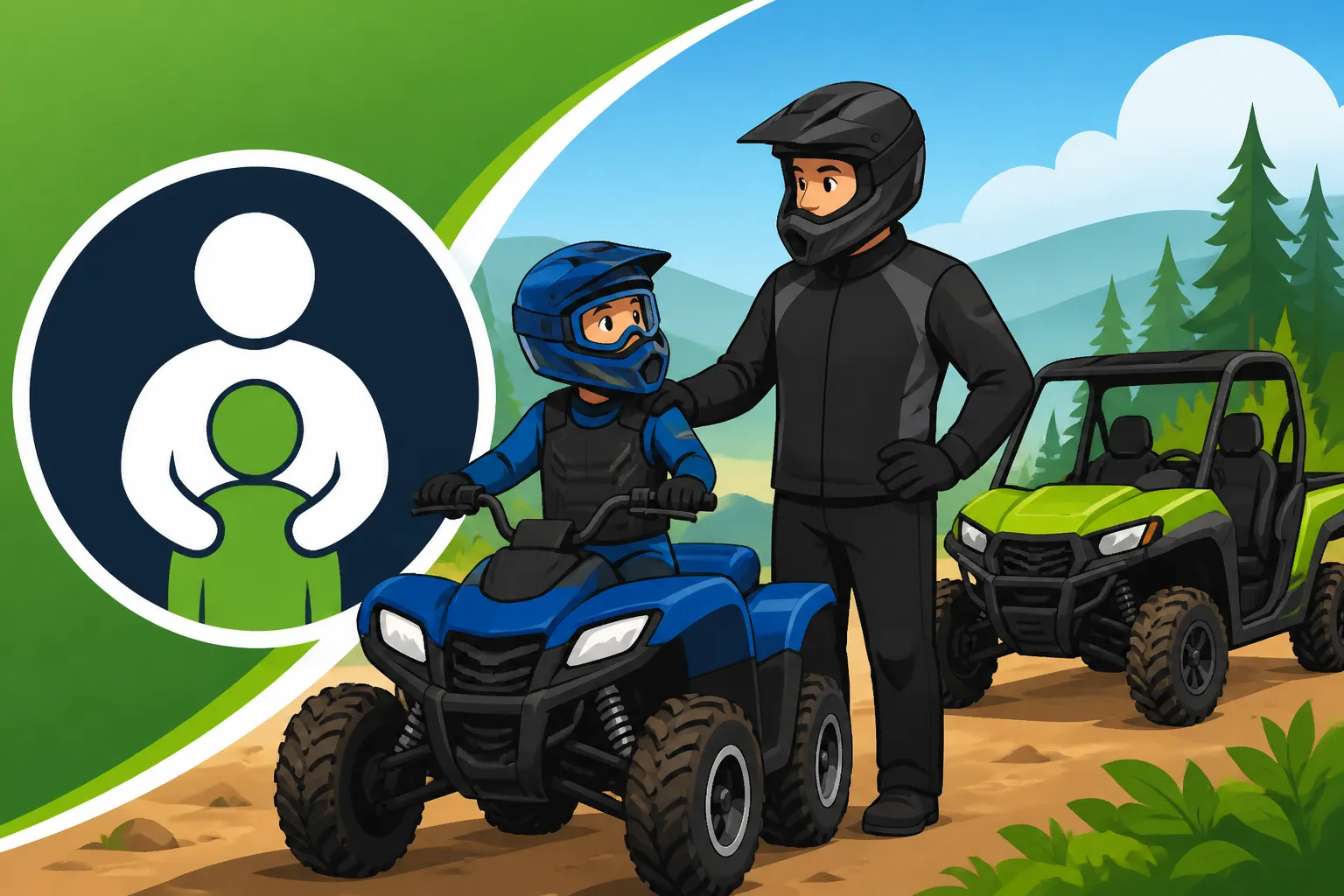
Ontario’s key supervision rule applies to anyone under 12 who drives an off-road vehicle. In general, a child in this age group may operate one only under the direct supervision of someone who is at least 16. There is a limited exception for riding on land occupied by the owner of the vehicle.
That exception is about where the vehicle is being operated; it is not permission to take a child onto a trail or road without checking the rules that apply there. If the machine leaves the qualifying land, the exception may no longer apply. A route that crosses a road or continues onto a trail network needs to be considered separately.
“Direct supervision” should not be treated as a box to tick by having an older person somewhere on the property. The supervisor needs to be close enough and attentive enough to oversee the child’s operation. The law’s requirements do not replace sound judgment about whether the supervisor can actually help if the child loses control or encounters a hazard.
The age and location rules can be summarized like this:
| Rider and location | General rule to keep in mind |
|---|---|
| Under 12, away from the land exception | Direct supervision by someone at least 16 is required |
| Under 12, on land occupied by the vehicle’s owner | A limited exception may apply; it does not automatically extend to roads or trails |
| Age 12 to 15, off-road | The under-12 supervision rule no longer applies, but the rider must still follow other laws and trail requirements |
| Under 16, on a highway | Do not operate the ORV there; supervision does not remove the age restriction |
| Age 16 or older | Age alone does not establish that road riding is allowed; licence, machine, equipment and local-road rules still matter |
For a closer look at the age threshold itself, see Ontario ATV Minimum Age Off-Road and Ontario ATV Minimum Age on a Road. The distinction matters: a young person may be allowed to operate a machine in one setting but not another.
Supervision does not make road riding legal
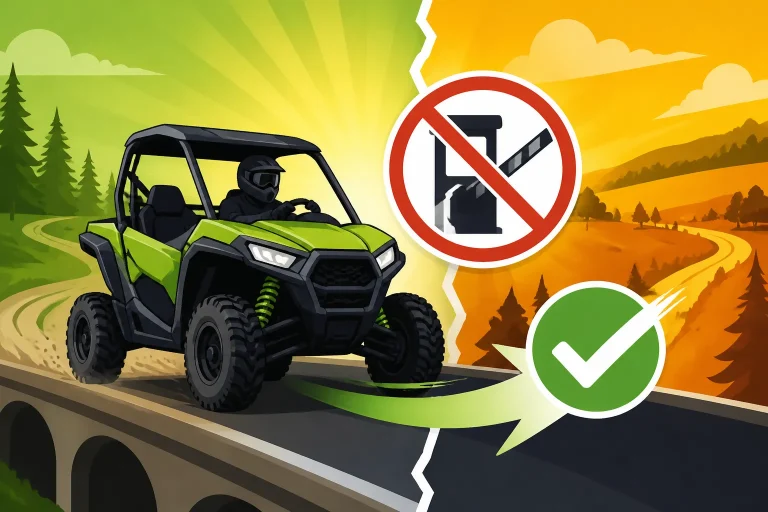
The most important limit for families to understand is that supervision does not override Ontario’s restriction on riders under 16 operating an off-road vehicle on a highway. An adult riding beside a child does not make an otherwise prohibited road trip lawful.
In this context, “highway” can cover more than a large, busy road. A municipal road may qualify, and a short road crossing can raise the same issue as riding along the road. Do not assume a quiet concession road, shoulder or brief connection between trails is exempt. Check whether the specific route is open to the vehicle and whether the rider meets the legal requirements for that road.
For riders old enough to operate on a road, more rules apply than supervision. Depending on the machine and road, the operator may need a qualifying driver’s licence, and the vehicle must meet the relevant requirements. Municipalities may also restrict which roads are open, when riding is allowed and where an ORV may travel. Ontario ATV Rules on a Municipal Road explains why permission to ride one road does not mean the next road is open.
A practical family rule is to plan a minor’s route so it does not rely on using a road as a shortcut. Confirm the route with the municipality or trail operator, and do not let an adult’s presence substitute for checking the rider’s eligibility. If a route requires a road crossing, confirm the applicable rules before setting out; for riders under 16, adult supervision is not a workaround.
Age is only one part of deciding whether a child should ride
The law sets a minimum standard. It does not guarantee that a child is physically or emotionally ready for a particular machine. A legal age threshold cannot account for a rider’s reach, strength, coordination, judgment, experience or ability to respond calmly when the terrain changes.
Choose a vehicle the child can control without straining to reach the controls or shifting awkwardly to steer. A machine that is too heavy or powerful can be difficult to manage even at low speed. For a UTV, make sure the child can sit correctly, use the available restraints and follow instructions. A seat in a side-by-side does not automatically mean the child is ready to operate it.
Before a first ride, explain the controls and agree on simple rules: where the child may go, how far they may get ahead, when they must stop, and what signal to use if they need help. Start in a familiar, flat area with room to practise stopping and turning. Avoid introducing unfamiliar terrain, passengers and a group pace all at once.
A few checks help turn a vague idea of supervision into a safer plan:
- Choose a suitable area. Confirm who owns or occupies the land and whether riding is allowed there. Do not assume that open-looking land is available for riding.
- Check the rider’s age against the location. Apply the under-12 supervision rule where required, and keep anyone under 16 off highways.
- Match the machine to the child. Consider the vehicle’s size and controls as well as the rider’s ability to operate it.
- Set boundaries before starting. Agree on the route, stopping points, signals and what the child should do if separated from the supervisor.
- Use protective equipment. A properly fitted helmet is a basic precaution. Check the rules that apply to the riding location, and review Ontario ATV Helmet Law for more detail.
- Reassess as conditions change. Mud, steep ground, poor visibility or fatigue can make a route unsuitable even if the child handled easier ground well.
For ideas on age-appropriate preparation, see Ontario ATV Training for Young Riders. Training can help build skills, but it does not change the legal age limits or make every machine appropriate for every child.
Trails, passengers and other rules still apply
Permission to ride on private land is not the same as permission to ride on a managed trail. Trail access may depend on a trail pass, the route’s rules and the operator’s own conditions. A pass or club rule cannot waive a law, and an adult supervisor cannot make a closed trail open. Check the trail operator’s current requirements before taking a minor onto its network.
Also consider whether the machine is registered and insured for the way it will be used. Registration, insurance and trail access are separate matters, and satisfying one does not automatically satisfy the others. For the insurance rules, see Ontario ATV Insurance Requirement. If you are riding a borrowed or rented machine, confirm that the owner or rental provider permits a minor to operate it and that the arrangement meets the applicable requirements.
Passengers need separate consideration. A child who is permitted to drive is not automatically permitted to carry another rider. The vehicle must be designed for the number of people aboard, and passengers must use the intended seating and restraints. Do not carry a passenger on a machine designed for one rider, or assume that a child can safely ride as a passenger just because an adult is driving. See Ontario ATV Passenger Rules before planning a two-up ride.
On private land, be clear about the property boundary and get permission from the person entitled to give it. An adjacent field, woodlot or road allowance is not automatically part of the riding area. If the planned ride leaves the land where the private-property exception applies, reassess the rules before continuing. What a 12-Year-Old May Ride on Private Land covers the private-land question in more detail.
A useful way to plan is to separate the decisions: Is the rider old enough for this location? Is the machine suitable? Is the land or trail open to riding? Are the registration, insurance, passenger and safety requirements met? If any answer is unclear, pause and confirm it rather than relying on an adult’s presence as a blanket permission.
Disclaimer
This article is for general informational purposes only and does not constitute professional advice. Laws, prices and regulations vary by location and change over time. Consult a qualified professional for guidance on your specific situation.